
Your organization just spent three months training the sales team on a new consultative approach. Everyone attended. The feedback forms were positive.
Six months later, sales numbers haven’t budged. People are selling exactly the same way they always have. What went wrong?
This scenario plays out constantly. Organizations measure training activity instead of impact. They count attendance and satisfaction scores, then wonder why performance doesn’t improve.
The problem isn’t that training doesn’t work. The problem is measuring the wrong things. Real learning evaluation answers the question that actually matters: did this training change anything important?
Understanding Learning Evaluation
Learning evaluation compares expectations to reality. Before training, you have goals and desired outcomes. After training, evaluation reveals whether those outcomes materialized and why.
This sounds simple but gets confused with assessment, which is different.
Assessment focuses on individuals:
- Did Maria understand the new framework?
- Can Tom demonstrate the technique?
- What did each person learn?
Learning evaluation focuses on impact:
- Are people using new skills with customers?
- Have conversations with clients changed?
- Are deals closing differently?
The sales team might have learned perfectly. But if they’re not applying it, if deals aren’t closing differently, the training didn’t deliver organizational value.
Both perspectives matter. Assessment tells you if training transferred knowledge. Learning evaluation tells you if that transfer mattered to business results.
Three Questions Learning Evaluation Must Answer
Question 1: Do Original Goals Still Make Sense?
Learning needs often shift during programs. Business priorities change mid-course. Market conditions evolve. Individual roles transform.
Sometimes the most valuable learning wasn’t what you originally planned. It emerged from unexpected participant interactions or realizations during training.
Rigid learning evaluation that only measures original objectives misses valuable unplanned outcomes. Flexible evaluation asks whether current outcomes align with current needs, not just initial plans.
Question 2: How Effective Were the Processes?
Even when training achieves desired results, understanding how matters for repeating success.
Process questions to examine:
- Were training formats appropriate for the content?
- Did timing work for participants’ schedules?
- Were resources adequate for effective learning?
- Did delivery methods engage people?
Process learning evaluation reveals whether to repeat similar approaches or modify them. Perfect execution of a flawed approach signals the need for different methods entirely.
Question 3: What Actually Changed?
This is where learning evaluation delivers greatest value. What’s different now compared to before training?
Vague answers don’t cut it:
- ❌ “People understand concepts better”
- ❌ “Awareness increased”
- ❌ “Engagement improved”
Real change looks like:
- ✓ Employees making different decisions
- ✓ New methods for approaching problems
- ✓ Collaboration happening in new ways
- ✓ Measurably better results
Without observable change, training consumed time and money without delivering value.
Evidence That Reveals the Truth
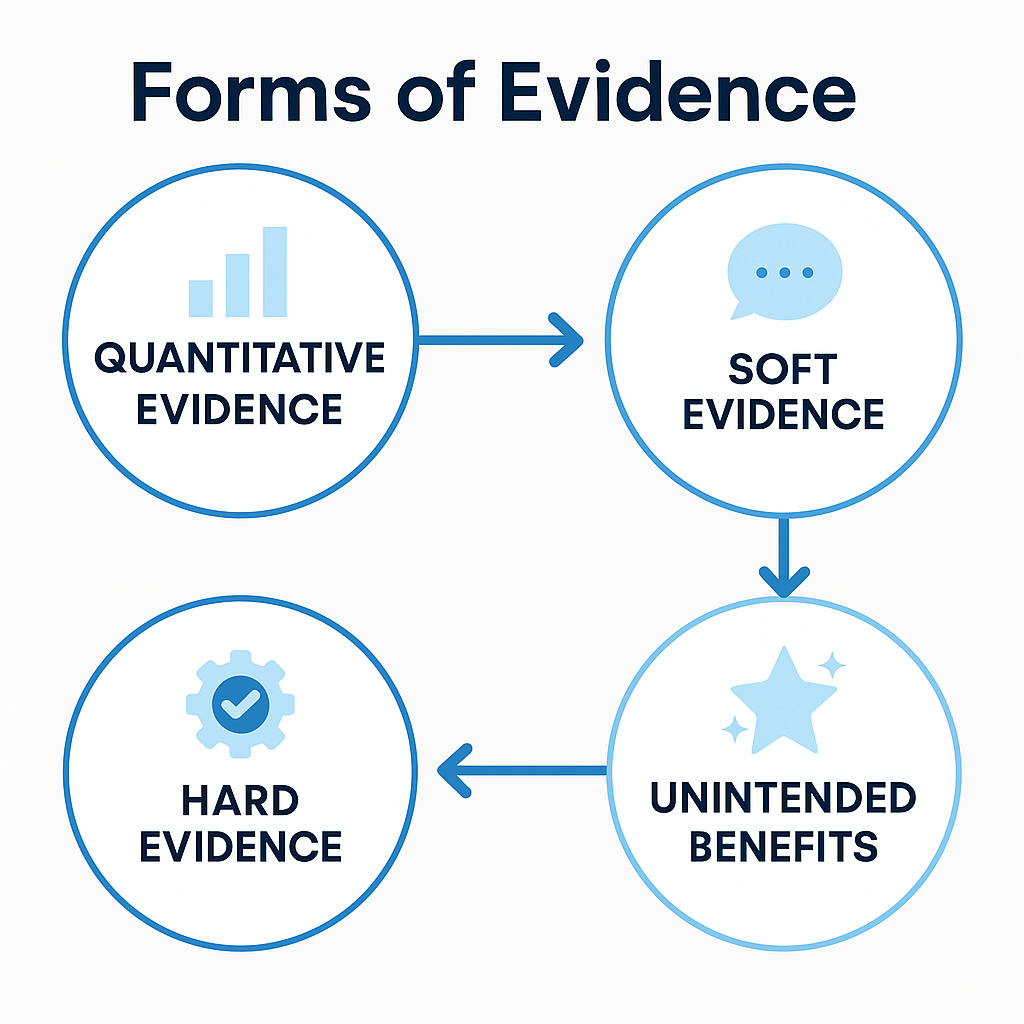
Learning evaluation requires both numbers and stories. Quantitative metrics provide measurable proof. Qualitative insights explain how and why change happened.
Quantitative Evidence for Learning Evaluation
Business metrics:
- Productivity improvements in specific areas
- Quality measurements showing fewer errors
- Safety incident reductions after training
- Customer satisfaction score increases
HR and talent metrics:
- Time to competence for new hires
- Promotion rates among trained employees
- Retention improvements in trained groups
- Reduced recruitment costs
Performance indicators:
- Revenue impact where directly measurable
- Efficiency gains in processes
- Cost reductions from improved methods
These numbers show what changed and by how much.
Qualitative Evidence for Learning Evaluation
Direct stakeholder feedback:
- Structured interviews with participants and managers
- Focus groups discussing real application examples
- Observations of how people work differently
Real-world stories:
- How someone applied learning to solve a problem
- Examples of improved decision-making
- Innovation sparked by training insights
Behavioral changes:
- New approaches to routine tasks
- Different collaboration patterns
- Changed problem-solving methods
Stories explain what the numbers mean. A 15% productivity increase is just a statistic. The story of how an employee used new skills to redesign a workflow brings that statistic to life.
Effective learning evaluation combines both. Numbers provide credibility and scale. Stories provide understanding and context.
Practical Learning Evaluation Framework
While no single approach fits every situation, certain questions provide structure for effective learning evaluation across different contexts.
Speed and capability questions:
- How quickly do new hires reach acceptable competence levels?
- What percentage of employees operate at target performance?
- How fast do people acquire new skills for emerging business needs?
Performance and effectiveness questions:
- What do customer satisfaction trends indicate about training impact?
- How successfully are people sharing knowledge across teams?
- What performance data suggests about skill application?
Talent development questions:
- What percentage of trained employees earn promotions?
- How much does reliance on external recruitment decrease?
- Are trained employees retained better than others?
Operational impact questions:
- What do productivity and safety data reveal?
- How effectively do teams collaborate across functions?
- What quality improvements can be measured directly?
These questions reveal whether training delivers value beyond checking completion boxes. They connect learning evaluation to outcomes that matter for business success.
Making Learning Evaluation Actually Useful
Learning evaluation fails when it becomes bureaucratic paperwork that nobody uses. Make it practical by following these principles.
Define success before training starts. Establish clear criteria everyone understands. Include both measurable outcomes and qualitative indicators. This prevents moving goalposts and provides objective evaluation standards.
Involve multiple perspectives. Training impacts various people. Gather input from participants, their managers, team members who work with them, and anyone affected by performance changes. Multiple perspectives reveal complete impact.
Communicate findings clearly. Dense reports that nobody reads waste evaluation effort. Share insights through brief summaries, visual dashboards showing key metrics, short case studies highlighting successes, and action-oriented recommendations.
Focus evaluation resources strategically. Don’t try evaluating everything exhaustively. Concentrate where training is most critical to business success, significant resources were invested, or questions exist about effectiveness.
Track patterns over time. Single data points tell incomplete stories. Monitor trends across multiple initiatives to identify what consistently works, which methods show limited effectiveness, and whether improvements sustain over time.
Capture unexpected benefits. Sometimes the most valuable outcomes weren’t planned. Stay alert to unplanned performance improvements, new collaboration patterns, or innovation sparked by bringing people together.
Using Learning Evaluation to Improve
Learning evaluation only matters when it drives better decisions. Use findings strategically.
When certain methods consistently produce stronger results in your learning evaluation data, increase their use. When approaches show limited impact, modify or eliminate them.
Direct training budgets toward programs delivering measurable returns. Reduce investment in activities showing weak results.
Process feedback from learning evaluation reveals what works in structure, timing, delivery methods, and support mechanisms. Apply these insights to future program design.
Identify facilitators delivering best outcomes. Learn from their practices and engage them for critical programs.
Sometimes learning evaluation reveals that poor outcomes result from organizational factors rather than program quality. Inadequate manager support, conflicting priorities, or lack of time to apply learning undermines effectiveness. Address these systemic barriers directly.
Images Credit : Chat GPT
Ready to build systematic learning evaluation into your human capital management? Discover how BPTW certification provides structured frameworks for measuring and improving employee development across the entire lifecycle.


