Your employer brand is your reputation as a place to work. It’s what people say about you when you’re not in the room. And it directly determines how easy or hard recruitment becomes.
Organizations with a strong, positive reputation as an employer attract talent easily. Organizations with weak or negative brands struggle to fill positions, even when offering competitive compensation. The difference isn’t just about difficulty. It’s about cost, time, and the quality of people you can ultimately hire.
What Is Employer Brand?
Employer brand encompasses the functional, economic, and psychological benefits that employees or prospective employees associate with working for your organization.
It includes:
Functional benefits: What the job actually involves, career development opportunities, work-life balance, and working environment.
Economic benefits: Compensation, benefits, job security, and financial stability of the organization.
Psychological benefits: Organizational culture, sense of purpose, social responsibility commitments, reputation, and how people feel about working there.
Your employer brand influences and is influenced by nearly all your HR practices. How you recruit, develop, manage performance, and treat departing employees all contribute to your reputation.
Within structured human capital frameworks such as HCM 3000, employer brand is treated as a recruitment system outcome, not a marketing asset. International guidance like ISO 30405 (Human resource management — Recruitment) reinforces the role of employer brand in attracting, assessing, and selecting suitable talent consistently.
Three Levels of Employer Brand Strength
Employer reputation as a place to work exists on a spectrum. Understanding where you sit helps determine what you need to improve.
Level 1: Awareness Have potential employees heard of your organization?
If people don’t know you exist, you’re starting from scratch with every recruitment effort. You’ll spend significant resources just getting noticed.
Level 2: Consideration Would potential employees consider working for you?
Awareness isn’t enough. People know many organizations they’d never want to work for. At this level, your organization makes people’s shortlist of potential employers.
Level 3: Preference Would potential employees rank you above other potential employers?
This is an employer of choice territory. When candidates have multiple offers, they choose you. When talented people think about changing jobs, they reach out to you first.
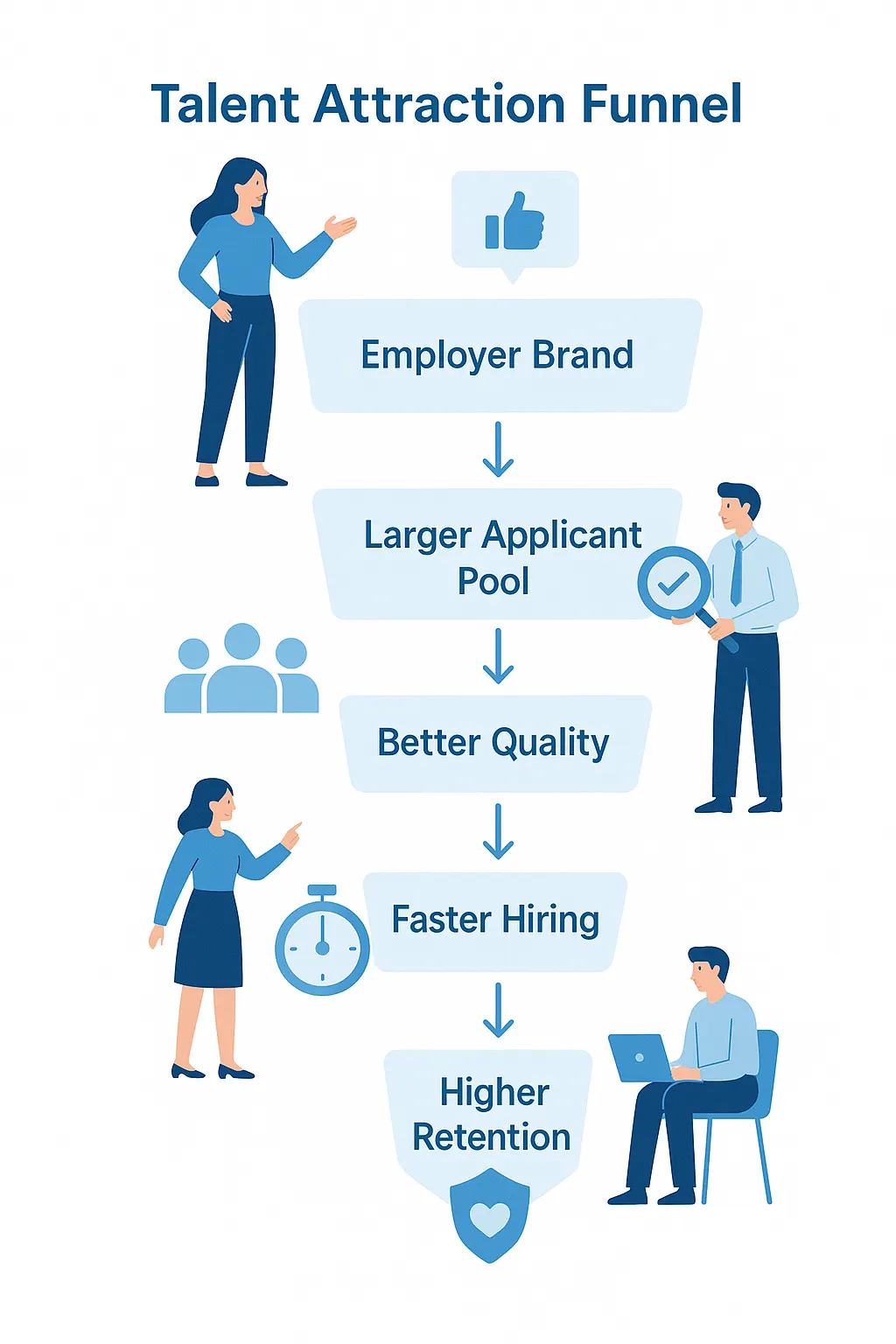
Moving up these levels dramatically changes recruitment dynamics. The higher your brand strength, the larger your applicant pool, the better the quality of candidates, and the fewer resources needed to fill positions.
Building Employer Brand Into Recruitment
BPTW Best Place To Work® certification evaluates whether employer brand is supported by consistent employee experience, leadership behavior, and recruitment outcomes rather than standalone messaging. The focus is on alignment between promise and reality.
Your employer brand should be visible throughout your recruitment process, not just mentioned in job ads.
Gather your existing materials. Collect current external communications including designs, logos, slogans, and phrases. Consistency matters. Your recruitment messages should align with your broader organizational messaging.
Identify cultural positives. What’s genuinely good about working at your organization? Don’t make things up. Identify authentic positives you can communicate honestly.
Understand external perceptions. What do customers, community members, and other stakeholders think about your organization? These perceptions influence whether people want to work for you.
Clarify leadership vision and values. What does leadership stand for? What matters to them? People increasingly want to work for organizations whose values align with their own.
Provide realistic job information. Overselling jobs backfires. People who join based on inflated promises leave quickly when reality doesn’t match expectations. Be honest about both positives and challenges.
Highlight unique positioning. What makes your organization different as an employer? What can you offer that others can’t or don’t?
Ensure message consistency. Your recruitment messages must not contradict messages from other parts of the organization. In fact, they should reinforce them. Contradictions destroy credibility.
Develop a deployment plan. How will you communicate your employer brand to target candidates? Through social media, marketing channels, public relations, employee testimonials, or direct outreach? Map out your approach by channel and audience.
Measuring Employer Brand Impact on Recruitment
You can’t improve what you don’t measure. Track metrics that reveal employer brand strength and its effect on recruitment outcomes.
1. Volume metrics:
- Total number of applicants per vacancy
- Number of unsolicited applications
- Number of employee referrals per vacancy
Strong employer brands generate more applications with less effort, including people proactively reaching out.
2. Quality metrics:
- Percentage of applicants meeting or exceeding job requirements
- Percentage of applicants advancing to candidate pools
- Job offer acceptance rate
Strong brands attract better-qualified candidates who are more likely to accept offers.
3. Efficiency metrics:
- Average time to fill vacancies
- Cost per hire
- Percentage of candidates who show up on their scheduled start date
Strong brands fill positions faster and more cost-effectively with fewer no-shows.
4. Retention metrics:
- Six-month and one-year retention rates for new hires
- Number of new employees promoted within typical time-frames
Strong brands attract people who stay and succeed, not just people who accept any job offer.
5. Perception metrics:
- Survey applicants about how employer brand influenced their decision to apply
- Survey candidates who rejected offers about why they chose differently
Direct feedback reveals whether your employer brand messaging resonates and where it falls short.
Compare these metrics against industry benchmarks. Good or bad is relative. What matters is how you perform compared to organizations competing for the same talent.
The Foundation: Corporate Brand
Difficult truth: you can’t build a strong employer brand without a solid corporate brand.
If your organization has a weak or negative reputation in the marketplace, that perception spills over into recruitment. People don’t compartmentalize. They don’t think “this company has terrible products and treats customers poorly, but I bet they’re a great employer.”
Focus on organizational culture, social responsibility commitments, work-life balance policies, compensation and benefits, and the value your organization brings to the community. These elements form the foundation of both corporate and employer brands.
Making It Authentic
The biggest mistake organizations make with employer branding is creating messages that sound good but don’t reflect reality.
Promising an innovative, fast-paced culture when you’re actually bureaucratic and slow doesn’t help recruitment. It might get people to apply, but they’ll leave quickly once they experience the truth. Then you’ve wasted recruitment resources and damaged your reputation further.
Build your employer brand on authentic strengths. If you don’t have certain strengths that matter to your target candidates, work on building them rather than pretending they exist.
People talk. Employees share their real experiences on review sites, with friends, and in professional networks. You can’t fake employer brand in the long term.
The Bottom Line
Your employer brand directly impacts recruitment outcomes. Organizations with strong, positive brands attract more applicants, better-qualified candidates, and higher offer acceptance rates while spending less time and money per hire.
Building an employer brand isn’t about clever marketing. It’s about creating a genuinely good place to work, understanding what makes you distinctive as an employer, and communicating those realities authentically to target candidates.
Measure your employer brand impact through recruitment metrics. Track not just how many people apply, but their quality, acceptance rates, and retention. Compare against industry benchmarks to understand where you stand.
Most importantly, ensure consistency between your employer brand messages and the actual employee experience. The gap between promise and reality determines whether your employer brand helps or hurts recruitment over time.
Image by: Chat GPT