Candidate Experience in Recruitment: An Essential Guide

Candidate experience is how job seekers perceive your organization throughout the recruitment process. It encompasses every interaction from initial awareness of your company through application, assessment, interviews, and offers. This experience shapes whether talented individuals want to work for you and what they tell others about your organization.

Within structured human capital management frameworks such as HCM 3000, candidate experience is treated as a measurable recruitment system outcome rather than a soft perception issue.

The Dual Evaluation Reality

Recruitment involves parallel assessments. While you evaluate candidates for job fit, they simultaneously evaluate you as a potential employer. Application processes, communication quality, assessment relevance, and interview professionalism all signal what working for your organization might be like.

Organizations that treat recruitment as purely evaluative miss this dynamic. Candidates aren’t passive subjects being screened. They’re making active decisions about whether to continue investing time in your process based on the experience you provide.
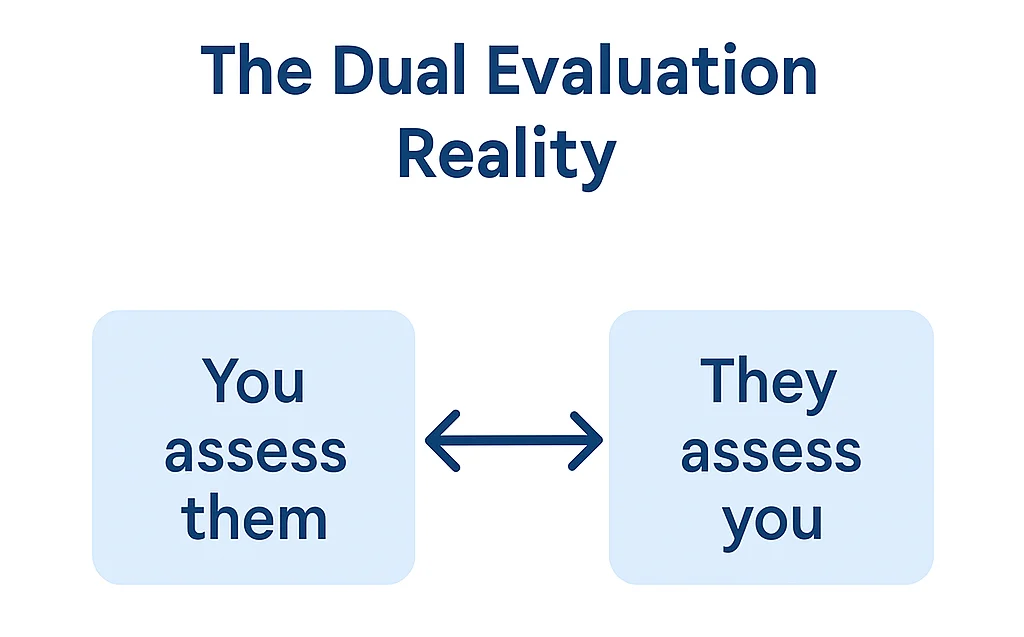
Candidate Experience- the dual evaluation

Why It Matters for Talent Acquisition

Poor candidate experiences drive quality applicants away, often after significant investment in sourcing and screening them. In competitive labor markets where demand for skilled talent exceeds supply, candidate experience frequently determines who succeeds in hiring.

ISO 30405 (Human resource management — Recruitment) emphasizes fair, transparent, and consistent recruitment practices, reinforcing candidate experience as a critical determinant of recruitment effectiveness and employer reputation.

The impact extends beyond individual vacancies. Candidates share their experiences through professional networks and platforms. Negative experiences damage your employer brand broadly, making future recruitment harder and more expensive across all roles.

Research indicates that recruitment experience affects post-hire outcomes. How candidates are treated during hiring influences their subsequent job satisfaction, engagement, and performance if employed. The process sets initial expectations and shapes perceptions that persist.

Employer Brand and Attraction

Before formal recruitment begins, your organization already has a reputation in the labor market. This employer brand reflects perceptions based on your business activities, public presence, and what current or former employees share about working there. Whether actively managed or not, this reputation exists and influences who applies to your opportunities.

BPTW Best Place To Work® certification evaluates candidate experience through recruitment consistency, communication quality, and alignment between employer brand promises and actual hiring practices.

Organizations with strong employer brands attract more qualified applicants and fill positions faster. Those with weak or negative reputations struggle to generate interest despite competitive compensation. Digital platforms amplify these reputations, giving candidates unprecedented access to insider perspectives.

Attraction isn’t passive. Organizations that engage potential talent before specific vacancies arise position themselves favorably when those individuals later explore opportunities. This proactive relationship-building creates awareness that converts to applications during active recruitment.

Process Design Impact

Every recruitment touch-point affects candidate perception. Confusing application systems frustrate applicants. Slow communication or no communication signals disrespect. Assessments that seem arbitrary or irrelevant create negative impressions about organizational judgment.

Key recruitment touch-points that shape candidate experience include:

  • Job advertisement clarity
  • Application system usability
  • Timeliness of communication
  • Interview structure and professionalism
  • Transparency of decision-making

Fairness, respect, and relevance are critical throughout. When candidates understand why assessments are used and feel the process treats them equitably, perception remains positive even when they’re not selected. Conversely, opaque or seemingly unfair processes generate resentment that gets shared publicly.

The information exchange during recruitment matters significantly. Candidates continue researching your organization throughout the process. How you respond to questions, the clarity of role descriptions, and the professionalism of interviewers all contribute to their developing understanding of you as an employer.

Dropout Intelligence

Not every candidate who begins your process completes it. Some exit during application, others after initial screening. Understanding why people drop out provides valuable insight into process weaknesses.

Dropouts caused by poor communication, excessive delays, or negative interactions reveal fixable problems. Dropouts due to better opportunities elsewhere or personal circumstances are inevitable but less actionable. Distinguishing between these categories helps focus improvement efforts where they’ll have impact.

Measurement Drives Improvement

Organizations serious about candidate experience measure it systematically. Relevant metrics include applicant volume per vacancy, progression rates through recruitment stages, offer acceptance ratios, and candidates who actually start employment.

Survey feedback from all participants, including those who drop out or decline offers, reveals what’s working and what needs attention. Third-party administration increases honesty by removing concerns about bias or repercussion.

These measurements inform resource allocation decisions. Which recruitment sources produce quality applicants? Where do candidates exit the process most frequently? What aspects of the experience receive consistent criticism? Answers guide targeted improvements rather than guessing at problems.

The Compounding Effect

Candidate experience compounds over time. Organizations that consistently deliver positive experiences build reputations that strengthen with each hiring cycle, making subsequent recruitment easier. Those that neglect experience face increasing difficulty as negative reputations spread and calcify.

Recovery from damaged employer brands requires sustained improvement over extended periods. Prevention through good practice is far more efficient than reputation repair after problems become entrenched.

Market Context

Labor markets increasingly favor candidates, particularly for specialized or high-demand skills. Organizations compete for the same talent pools, differentiating through compensation, opportunity, and how they treat people during recruitment.

In this environment, candidate experience becomes competitive advantage. Organizations that provide professional, respectful engagement throughout recruitment succeed more consistently than those viewing the process as something done to candidates rather than with them.

The shift toward candidate-driven markets means talent acquisition increasingly resembles customer acquisition. Just as poor customer experience drives buyers to competitors, poor candidate experience drives talent elsewhere. Organizations that recognize this parallel adapt recruitment accordingly.

Image by : Chat GPT

Organizations that recognize recruitment as a strategic capability invest in systematic approaches to candidate experience. Learn how BPTW certification provides frameworks for structured recruitment, hiring, and talent management that build your reputation as an employer of choice.


Recruitment Planning Framework: Strategic Hiring Success

Recruitment planning separates organizations that consistently hire great talent from those that struggle with costly mis-hires and prolonged vacancies. Without a structured approach, recruitment becomes reactive, expensive, and misaligned with business needs. Strategic planning transforms hiring into a competitive advantage.

Within structured human capital frameworks such as HCM 3000, recruitment planning is treated as a core workforce capability rather than an administrative task.

Effective recruitment planning connects workforce needs, market realities, and hiring decisions into a single, repeatable process.

Why Recruitment Planning Drives Results

Effective recruitment planning ensures your hiring process meets organizational needs efficiently. It reduces time-to-hire, improves candidate quality, and creates a positive experience that strengthens your employer brand. Most importantly, it ensures every stakeholder knows their role and timeline, eliminating bottlenecks that delay critical hires.

ISO 30405 (Human resource management — Recruitment) reinforces the importance of structured recruitment planning aligned with organizational needs, role requirements, and consistent hiring practices.

Analyzing Your Job Market Context

Understanding Talent Availability

The job market changes constantly. Before launching recruitment, assess talent availability in your sector and location. Consider mobility patterns, emerging skill sets, and competitor activity. This intelligence helps you position opportunities realistically.

Practical research approaches:

  • Review government employment statistics for your industry
  • Consult recruitment agencies familiar with your talent pool
  • Post exploratory job ads to gauge response rates
  • Network with industry peers about hiring conditions

If information is scarce, test the market with a general job posting on popular platforms to understand candidate availability and expectations.

how recruitment planning affects employer brand

Employer Brand Impact on Recruitment

BPTW Best Place To Work® certification evaluates whether employer brand claims are supported by consistent recruitment practices and candidate experience, not marketing statements.

Your employer brand (how candidates perceive working for your organization) directly affects recruitment outcomes. A positive brand attracts quality candidates and reduces hiring costs. A negative brand makes every hire harder and more expensive.

Consider your current employer brand reputation when designing your recruitment approach. Remember that every interaction during recruitment either strengthens or damages your brand.

Slow responses, unclear communication, or disorganized processes send negative signals to candidates who will share their experiences online and with peers.

Compensation Strategy

Budget constraints are real, but compensation directly impacts recruitment effectiveness. This includes base salary, performance bonuses, benefits packages, and non-monetary perks. Understanding your compensation positioning relative to market rates helps you set realistic expectations and craft compelling offers.

If your compensation is below market, acknowledge this in planning and emphasize other value propositions like growth opportunities, work flexibility, or company culture.

Building Clear Role Definitions

Crafting Effective Job Descriptions

A strong job description serves the entire recruitment process and beyond. It should clearly outline the role’s responsibilities, work environment, performance expectations, and reporting structure. This clarity helps candidates self-select appropriately and provides a foundation for on-boarding and performance reviews.

Include practical details: team structure, key projects, success metrics for the first 90 days, and growth trajectory. Avoid generic corporate language that tells candidates nothing meaningful about the actual work.

Developing Person Specifications

Person specifications define the essential criteria for candidate selection. This includes minimum education levels, required experience, technical competencies, and behavioral characteristics necessary for success.

Critical consideration: Ensure specifications reflect genuine job requirements, not personal biases or discriminatory preferences. Question whether each criterion is truly essential or merely “nice to have.” Over-specifying requirements unnecessarily narrows your talent pool.

Base specifications on structured requirements analysis rather than assumptions about ideal candidates. What does someone actually need to succeed in this role within your specific organizational context?

Coordinating Stakeholders Effectively

Identifying Key Players

Successful recruitment requires coordinated involvement from multiple stakeholders. Identify everyone who needs to participate: hiring managers, team members, HR professionals, senior leadership, and potentially external partners.

Define each stakeholder’s role clearly: Who screens applications? Who conducts interviews? Who makes the final decision? Who handles offer negotiations? Ambiguity here creates delays and confusion.

Managing Stakeholder Engagement

Secure stakeholder commitment early. Ensure everyone understands their responsibilities and timeline commitments. One unavailable interviewer can derail an entire recruitment process and lose strong candidates to competing offers.

Scheduling for Success

Creating Realistic Timelines

Map out your recruitment timeline with specific milestones: when job postings go live, application deadlines, screening completion dates, interview periods, decision points, and offer delivery.

Key scheduling elements:

  • Advertisement placement timing and duration
  • Application review periods
  • Assessment and interview dates
  • Candidate communication touch-points
  • Decision-making deadlines
  • Offer presentation and negotiation windows

Build buffer time for delays. Candidates have notice periods, stakeholders get sick, and decisions take longer than planned. Aggressive timelines create stress and poor decisions.

Maintaining Candidate Momentum

Long gaps between recruitment stages lose candidates to other opportunities. Schedule efficiently to maintain engagement. If delays occur, communicate proactively. Silence kills candidate interest faster than anything else.

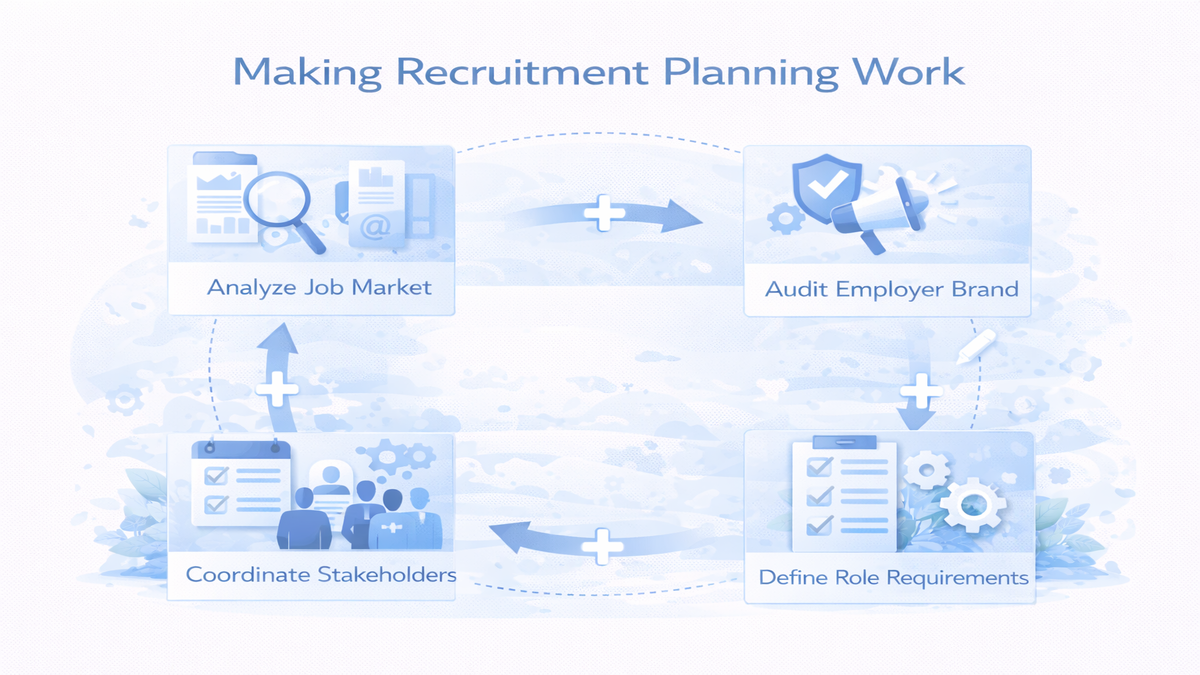
Making recruitment planning work

Making Recruitment Planning Work

Strategic recruitment planning isn’t bureaucracy. It’s the difference between hiring the right people efficiently and struggling with costly recruitment failures. Organizations that plan intentionally create better candidate experiences, make smarter hiring decisions, and build stronger teams.

Key takeaways for immediate implementation:

  • Research your job market before designing your approach
  • Audit your employer brand and address reputation issues
  • Create specific, unbiased role requirements
  • Secure stakeholder commitment with clear timelines
  • Schedule realistically with buffer time built in

Structured recruitment planning creates accountability, consistency, and measurable results. It transforms hiring from a necessary hassle into a strategic capability that drives organizational performance.

Employer Brand and Recruitment: Why Your Reputation Matters

Your employer brand is your reputation as a place to work. It’s what people say about you when you’re not in the room. And it directly determines how easy or hard recruitment becomes.

Organizations with a strong, positive reputation as an employer attract talent easily. Organizations with weak or negative brands struggle to fill positions, even when offering competitive compensation. The difference isn’t just about difficulty. It’s about cost, time, and the quality of people you can ultimately hire.

What Is Employer Brand?

Employer brand encompasses the functional, economic, and psychological benefits that employees or prospective employees associate with working for your organization.

It includes:

Functional benefits: What the job actually involves, career development opportunities, work-life balance, and working environment.

Economic benefits: Compensation, benefits, job security, and financial stability of the organization.

Psychological benefits: Organizational culture, sense of purpose, social responsibility commitments, reputation, and how people feel about working there.

Your employer brand influences and is influenced by nearly all your HR practices. How you recruit, develop, manage performance, and treat departing employees all contribute to your reputation.

Within structured human capital frameworks such as HCM 3000, employer brand is treated as a recruitment system outcome, not a marketing asset. International guidance like ISO 30405 (Human resource management — Recruitment) reinforces the role of employer brand in attracting, assessing, and selecting suitable talent consistently.

Three Levels of Employer Brand Strength

Employer reputation as a place to work exists on a spectrum. Understanding where you sit helps determine what you need to improve.

Level 1: Awareness Have potential employees heard of your organization?

If people don’t know you exist, you’re starting from scratch with every recruitment effort. You’ll spend significant resources just getting noticed.

Level 2: Consideration Would potential employees consider working for you?

Awareness isn’t enough. People know many organizations they’d never want to work for. At this level, your organization makes people’s shortlist of potential employers.

Level 3: Preference Would potential employees rank you above other potential employers?

This is an employer of choice territory. When candidates have multiple offers, they choose you. When talented people think about changing jobs, they reach out to you first.

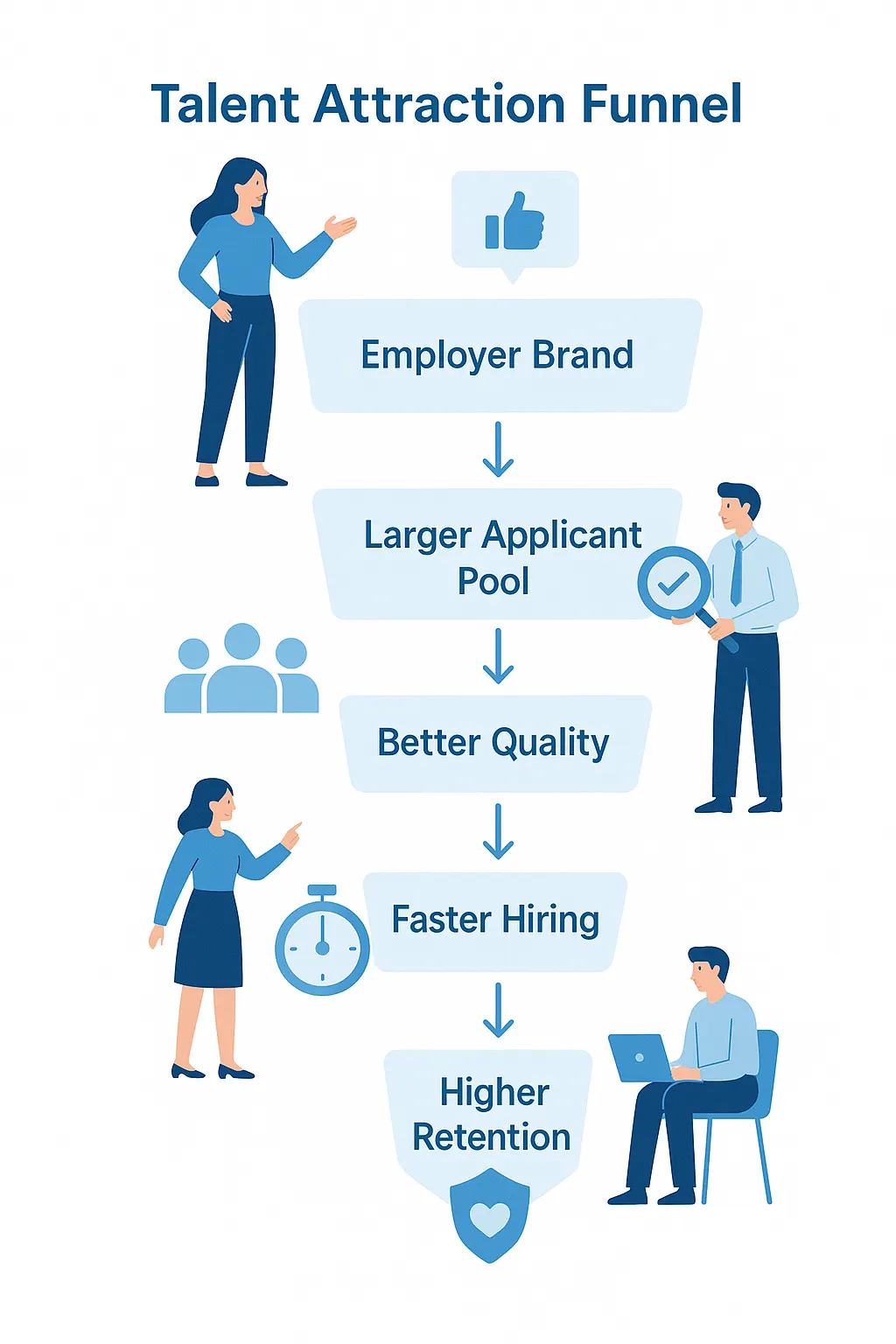
Moving up these levels dramatically changes recruitment dynamics. The higher your brand strength, the larger your applicant pool, the better the quality of candidates, and the fewer resources needed to fill positions.

Building Employer Brand Into Recruitment

BPTW Best Place To Work® certification evaluates whether employer brand is supported by consistent employee experience, leadership behavior, and recruitment outcomes rather than standalone messaging. The focus is on alignment between promise and reality.

Your employer brand should be visible throughout your recruitment process, not just mentioned in job ads.

Gather your existing materials. Collect current external communications including designs, logos, slogans, and phrases. Consistency matters. Your recruitment messages should align with your broader organizational messaging.

Identify cultural positives. What’s genuinely good about working at your organization? Don’t make things up. Identify authentic positives you can communicate honestly.

Understand external perceptions. What do customers, community members, and other stakeholders think about your organization? These perceptions influence whether people want to work for you.

Clarify leadership vision and values. What does leadership stand for? What matters to them? People increasingly want to work for organizations whose values align with their own.

Provide realistic job information. Overselling jobs backfires. People who join based on inflated promises leave quickly when reality doesn’t match expectations. Be honest about both positives and challenges.

Highlight unique positioning. What makes your organization different as an employer? What can you offer that others can’t or don’t?

Ensure message consistency. Your recruitment messages must not contradict messages from other parts of the organization. In fact, they should reinforce them. Contradictions destroy credibility.

Develop a deployment plan. How will you communicate your employer brand to target candidates? Through social media, marketing channels, public relations, employee testimonials, or direct outreach? Map out your approach by channel and audience.

Employer brand Talent attraction funnel

Measuring Employer Brand Impact on Recruitment

You can’t improve what you don’t measure. Track metrics that reveal employer brand strength and its effect on recruitment outcomes.

1.  Volume metrics:

  • Total number of applicants per vacancy
  • Number of unsolicited applications
  • Number of employee referrals per vacancy

Strong employer brands generate more applications with less effort, including people proactively reaching out.

2. Quality metrics:

  • Percentage of applicants meeting or exceeding job requirements
  • Percentage of applicants advancing to candidate pools
  • Job offer acceptance rate

Strong brands attract better-qualified candidates who are more likely to accept offers.

3. Efficiency metrics:

  • Average time to fill vacancies
  • Cost per hire
  • Percentage of candidates who show up on their scheduled start date

Strong brands fill positions faster and more cost-effectively with fewer no-shows.

4. Retention metrics:

  • Six-month and one-year retention rates for new hires
  • Number of new employees promoted within typical time-frames

Strong brands attract people who stay and succeed, not just people who accept any job offer.

5. Perception metrics:

  • Survey applicants about how employer brand influenced their decision to apply
  • Survey candidates who rejected offers about why they chose differently

Direct feedback reveals whether your employer brand messaging resonates and where it falls short.

Compare these metrics against industry benchmarks. Good or bad is relative. What matters is how you perform compared to organizations competing for the same talent.

The Foundation: Corporate Brand

Difficult truth: you can’t build a strong employer brand without a solid corporate brand.

If your organization has a weak or negative reputation in the marketplace, that perception spills over into recruitment. People don’t compartmentalize. They don’t think “this company has terrible products and treats customers poorly, but I bet they’re a great employer.”

Focus on organizational culture, social responsibility commitments, work-life balance policies, compensation and benefits, and the value your organization brings to the community. These elements form the foundation of both corporate and employer brands.

Making It Authentic

The biggest mistake organizations make with employer branding is creating messages that sound good but don’t reflect reality.

Promising an innovative, fast-paced culture when you’re actually bureaucratic and slow doesn’t help recruitment. It might get people to apply, but they’ll leave quickly once they experience the truth. Then you’ve wasted recruitment resources and damaged your reputation further.

Build your employer brand on authentic strengths. If you don’t have certain strengths that matter to your target candidates, work on building them rather than pretending they exist.

People talk. Employees share their real experiences on review sites, with friends, and in professional networks. You can’t fake employer brand in the long term.

The Bottom Line

Your employer brand directly impacts recruitment outcomes. Organizations with strong, positive brands attract more applicants, better-qualified candidates, and higher offer acceptance rates while spending less time and money per hire.

Building an employer brand isn’t about clever marketing. It’s about creating a genuinely good place to work, understanding what makes you distinctive as an employer, and communicating those realities authentically to target candidates.

Measure your employer brand impact through recruitment metrics. Track not just how many people apply, but their quality, acceptance rates, and retention. Compare against industry benchmarks to understand where you stand.

Most importantly, ensure consistency between your employer brand messages and the actual employee experience. The gap between promise and reality determines whether your employer brand helps or hurts recruitment over time.

Image by: Chat GPT

Quality of Hire: How to Measure Recruitment Success

You filled the position quickly and stayed under budget. But did you actually hire the right person?

Quality of hire answers this critical question. It reveals whether your recruitment process consistently brings in people who succeed in their roles and contribute to organizational goals.

Without measuring the quality of hire, you’re flying blind. You might be filling seats efficiently while building a workforce that under-performs. Here’s how to measure what actually matters.

Within structured human capital management systems such as HCM 3000, quality of hire is treated as a core recruitment effectiveness indicator rather than a standalone HR metric. It aligns recruitment decisions with workforce capability requirements and long-term performance outcomes, ensuring hiring activity supports organizational sustainability rather than short-term vacancy filling.

What Quality of Hire Actually Measures

Quality of hire assesses how well new employees align with job requirements and organizational expectations.

It’s the reality check for your recruitment process. When quality of hire metrics drop, something in your hiring system needs attention. Maybe your interviews don’t predict job success. Perhaps your candidate assessment methods miss what actually matters for performance.

This metric provides the evidence you need to improve recruitment systematically rather than guessing at problems.

International guidance such as ISO 30411 (Human resource management — Quality of hire metric) reinforces the need to define success criteria before hiring and evaluate outcomes after placement through structured quality of hire measurement.

Three Core Principles of Quality of Hire Measurement:

  • Comparative: actual performance versus defined expectations
  • Multidimensional: success includes performance, capability, and contribution
  • Time-based: measured at agreed milestones (3, 6, 9, or 12 months)

Understanding quality of hire connects directly to effective recruitment planning that sets clear success criteria from the start.

Why Quality of Hire Matters

Most organizations obsess over time-to-hire and cost-per-hire. These metrics matter, but they’re incomplete.

Hiring someone quickly and cheaply who then fails costs far more than taking longer to find the right person. Poor QoH creates cascading problems: lost productivity, team disruption, replacement costs, and damaged morale.

Quality of hire shifts focus from activity metrics to outcome metrics. Instead of celebrating how many positions you filled, you evaluate whether you hired people who actually succeed.

BPTW Best Place To Work® certification evaluates whether organizations consistently measure quality of hire and use results to improve recruitment decisions, onboarding effectiveness, and workforce allocation rather than treating hiring as a transactional activity.

Two Proven Measurement Approaches

Organizations typically use one or both of these methods to measure QoH.

Approach 1: Performance Against Objectives

This method evaluates new hires based on measurable performance objectives.

After a defined review period, compare actual achievement against assigned goals. Performance ratings link directly to organizational objectives and capture manager satisfaction with the hire’s contributions.

How it works: Calculate the mean performance rating for new hires during their first evaluation period. Compare this against your baseline expectation (typically your “acceptable” performance threshold).

If your acceptable performance rating is 3 on a 5-point scale and your new hires average 3.3, your quality of hire exceeds expectations by 11%. If they average 2.5, you have a recruitment problem to diagnose.

This approach integrates naturally with existing performance review systems. No need to create separate measurement processes.

Approach 2: Knowledge, Skills, and Abilities Assessment

This method uses structured questionnaires completed by hiring managers or key stakeholders.

They rate satisfaction with the new hire’s knowledge, skills, and abilities (KSAs) compared to pre-hire expectations. The assessment focuses on competencies critical for role success in your specific context.

How it works: Design a questionnaire covering essential KSAs for the role: technical knowledge, communication ability, problem-solving skills, relationship management, work quality, and timeliness.

Stakeholders rate each dimension on a defined scale. Calculate the mean rating across all dimensions. Compare this to your minimum expectation threshold.

If pre-hire expectation is a rating of 3 (acceptable) and the new hire averages 3.6 across all KSAs, quality of hire is 20% above expectations.

This measurement approach works particularly well when jobs don’t have easily quantifiable objectives or when you need granular insight into specific competency gaps. It also supports better candidate experience by clarifying what success actually looks like.


Choosing Your Quality of Hire Measurement Approach

Both approaches work. Your choice depends on organizational context and what you need to understand.

Use performance objectives measurement when jobs have clear, measurable goals and you already have established performance review processes. This approach integrates seamlessly with existing systems.

Use KSA assessment when you need detailed insight into specific competency gaps or when jobs don’t lend themselves to objective performance metrics. This works well for roles where success is more qualitative.

Many organizations use both methods for different role types or combine them for comprehensive assessment.

Critical Context Factors to Consider

Quality of hire doesn’t exist in isolation. Several factors influence your metrics and how you should interpret them.

Manager rating styles vary significantly. Some managers rate generously, others critically. Consistent low ratings from one manager might reflect their assessment approach rather than actual hire quality.

Choose appropriate timeframes. Decide whether to assess QoH at 3, 6, 9, or 12 months post-hire. Earlier assessment reveals onboarding and immediate fit issues. Later assessment shows sustained performance.

Different roles warrant different timeframes. Entry-level positions might be evident in three months. Senior technical roles may require twelve months for meaningful evaluation.

Quality of hire data feeds directly into workforce planning decisions by showing whether hiring pipelines are delivering the capabilities the organization actually requires.

Consider related metrics. QoH connects to cost-per-hire, time-to-fill, turnover rates, and retention. These relationships vary by organization size, sector, and growth phase.

High quality of hire with high turnover suggests problems in onboarding, management, or role clarity rather than recruitment. Low quality with long time-to-fill might indicate overly restrictive selection criteria that filter out capable candidates.

Making Quality of Hire Actionable

Measurement without action wastes effort. Quality of hire metrics should drive systematic improvement.

When QoH metrics fall below standards, investigate:

  • Are job descriptions attracting appropriate candidates?
  • Do assessment methods actually predict job success?
  • Is selection criteria aligned with what roles require?
  • Are hiring managers making consistent, objective decisions?
  • Does onboarding adequately prepare new hires for success?

Low quality of hire often reveals flaws in process design rather than bad luck with candidates. Use data to fix your recruitment system systematically.

Track trends over time. Single data points tell you little. Monitor QoH across multiple hiring cycles to identify patterns and measure improvement from process changes.

Close the feedback loop. Share quality of hire data with everyone involved in recruitment. When recruiters and hiring managers see how their selections perform, they make better future decisions.

Getting Started with Quality of Hire Measurement

Implementation steps:

  1. Define expectations before hiring – Document minimum acceptable performance levels and key competency requirements
  2. Choose your measurement approach – Select performance-based, KSA-based, or both depending on role types
  3. Set evaluation timeframes – Decide when to measure quality of hire (3, 6, 9, or 12 months)
  4. Standardize your measurement – Use consistent scales, time frames, and methods across similar roles
  5. Train evaluators – Ensure managers understand how to rate quality of hire fairly and consistently
  6. Analyze results regularly – Review quality of hire quarterly to identify trends
  7. Act on findings – Use quality of hire data to improve recruitment processes systematically

Effective workforce allocation depends on hiring quality talent in the first place. QoH measurement ensures your recruitment investments pay off.

Conclusion

Quality of hire transforms recruitment from activity-focused to outcome-focused.

It reveals whether your hiring process delivers people who actually succeed, not just whether you’re filling positions efficiently. This matters because recruitment effectiveness directly impacts organizational performance and competitive advantage.

Organizations that measure QoH systematically make better recruiting decisions over time. They learn which approaches work, which don’t, and how to continuously improve.

Start measuring the QoH, and you’ll stop guessing whether your recruitment process works.

Ready to strengthen recruitment outcomes and accountability?

BPTW certification assesses how organizations measure and improve quality of hire within structured human capital management systems, ensuring recruitment decisions support long-term performance.

AI in Recruitment: Building Fair and Effective Hiring

In today’s volatile, uncertain, complex and ambiguous (VUCA) environment, organizational talent needs are evolving rapidly. Organizations must not only identify the right talent but also properly assess candidates with high potential and determine how to recruit, manage and retain them effectively.

Recruitment is becoming increasingly data-driven, with AI adoption growing across industries. However, as multiple layers of technologies and tools enter the recruitment space, complexity increases when these systems are implemented without clear structure and oversight.

At BPTW Best Place To Work®, the use of AI in recruitment is evaluated within the broader context of structured human capital management. Under the HCM 3000 Standard, recruitment technologies are assessed not as standalone tools, but as components of a documented, auditable people system. This ensures that AI adoption supports fairness, validity, and governance rather than automating poorly designed hiring practices.

The Current AI in Recruitment Landscape

AI-powered recruitment technologies now cover the entire hiring process:

In sourcing and advertising, AI is used for job advert optimization through textual analysis, strategic job posting via marketing algorithms, and automated candidate search systems.

In screening and engagement, AI guides candidates with chatbots, parses CVs for keyword matching, automates reference checks, and screens social media profiles.

In assessment and evaluation, AI supports skills assessments, psychometric testing, automated interviews, and response analysis tools.

These techniques offer significant benefits including faster hiring cycles, broader candidate reach, and more consistent screening. However, they also introduce serious risks when implemented without proper safeguards.

These practices align with internationally recognized guidance, including ISO 30405 Annex A for structured recruitment processes.

The Bias Problem

The most critical concern with AI in recruitment is bias. If the training data contains bias, even unintentionally, the entire process can discriminate against candidates based on diversity dimensions or other unintended characteristics.

AI systems learn from historical data. When those patterns do not reflect real predictors of job performance, capable candidates can be excluded and hiring outcomes weakened. If trained on biased past decisions, algorithms replicate those preferences, amplifying disparities rather than reducing them.

This creates a troubling cycle where poorly designed AI systems amplify and systematize bias rather than reducing it.

In a VUCA environment, where roles evolve quickly and historical patterns lose relevance, this reliance on biased legacy data increases both ethical and performance risk.

Essential Implementation Guidelines

Training data transparency is foundational

Before implementing any AI in recruitment system, understand the data foundation. 

  • How many data sets were used, and what was their demographic distribution?
  • How was bias-free data selection ensured?
  • How was stereotyping identified and addressed?
  • How does the system handle candidates from different backgrounds?

If vendors cannot provide clear answers, you’re trusting an unverifiable system with decisions that significantly impact people’s careers.

Algorithm performance must be demonstrably fair

Algorithms should be empirically proven not to discriminate. Request these specific metrics:

  • Accuracy: Percentage of candidates correctly classified
  • Precision: Ratio of correctly identified qualified candidates to all flagged as qualified
  • Recall: Percentage of truly qualified candidates successfully identified
  • F1 Score: Balanced measure combining precision and recall

These metrics require regular monitoring, especially for machine learning systems where algorithms evolve over time.

Assessment tools must meet validity and reliability standards

AI assessment tools must meet established standards:

  • Objectivity: Consistent evaluation across time and reviewers
  • Reliability: Reproducible results for similar candidates
  • Criterion Validity: Proven correlation with actual job performance
  • Construct Validity: Accurate measurement of intended qualities
  • Fairness: Equitable treatment across all candidate groups

These are fundamental requirements, not optional extras.

Candidate transparency is a governance requirement

Inform candidates when AI influences their evaluation. Explain these key points:

  • When and where AI is used in the process
  • What data is collected and analyzed
  • How analyses influence hiring decisions
  • Whether recommendations are final or subject to human review

This builds trust, ensures legal compliance, and enables informed consent.

Organizations must understand how AI decisions are generated

Know what your AI system optimizes for, what inputs it considers, how it weighs factors, and what assumptions underpin its design. Without this understanding, you cannot evaluate whether the tool aligns with your values and obligations.

AI systems must account for non-standard career profiles

AI systems struggle with non-traditional profiles. This includes career changers, unconventional educational backgrounds, career gaps, or unique skill combinations. Ensure your system does the following:

  • Includes edge cases in training data
  • Flags unusual profiles for human review rather than automatic rejection
  • Can learn from successful edge cases

Human oversight remains essential in hiring decisions

Establish clear policies requiring human involvement for:

  • Final hiring decisions
  • Rejections of apparently strong candidates
  • Explaining decisions to candidates
  • Assessing cultural fit and growth potential

AI should support decision-making, not replace it entirely.

Legal and regulatory compliance must be continuously monitored

Legal frameworks around AI in hiring vary by jurisdiction and evolve rapidly. Some regions require bias audits, candidate disclosure, or restrict certain technologies. Organizations operating internationally must comply with regulations in every hiring location.

The Broader Context: Structured People Management

AI recruitment tools work best within structured human capital management systems. If your hiring process is inconsistent and poorly documented without AI, adding algorithms simply automates those problems.

Under structured frameworks such as HCM 3000, recruitment is evaluated alongside workforce planning, development, performance, and retention to ensure consistency and accountability.

Effective AI in recruitment requires clear job requirements, documented processes, alignment with business strategy, integration with other talent systems, and accountability mechanisms. When recruitment is managed alongside planning, development, performance, retention, and transitions as an integrated system, AI becomes a tool for building better workplaces rather than just faster hiring.

Establishing controlled AI adoption

Audit current tools. Identify what AI you’re already using and what safeguards exist.

Define standards. Document your performance and fairness requirements before evaluating vendors.

Start small. Implement AI in one area, monitor closely, then expand based on results.

Train your team. Ensure everyone understands how tools work and their limitations.

Create feedback loops. Enable recruiters, managers, and candidates to flag concerns.

Review regularly. Assess performance and fairness quarterly, adjusting as needed.

Conclusion

Adopting AI in recruitment within a structured people management system ensures that technology supports better hiring decisions rather than replacing human judgment.

When implemented within structured people management systems, AI in recruitment becomes a governance tool rather than a shortcut. Clear requirements, documented processes, and ongoing evaluation allow organizations to benefit from automation without compromising fairness or accountability. In this context, AI supports better hiring decisions by strengthening human judgment, not replacing it.

Upcoming Webinar : Learn About BPTW – Best Place to Work

Join our upcoming webinar to learn how BPTW certification can help your organization build structured people systems that drive business success.

Date:

10th september 2025

Time:

4.00 PM - 4.30PM IST