
Your organization hosts pizza Fridays, game nights, and team-building activities. Everyone seems to enjoy them. Yet turnover remains high, productivity hasn’t improved, and people still seem disconnected from their work.
Here’s why: those activities aren’t employee engagement. They’re perks. Real employee engagement goes much deeper and delivers far greater business impact.
Understanding what employee engagement actually means, and what it isn’t, matters because organizations that get this right see measurably better performance, retention, and results.
Within structured human capital frameworks such as HCM 3000, aligned with ISO 23326, employee engagement is treated as a measurable workforce outcome rather than a cultural initiative.
BPTW Best Place To Work® evaluates engagement maturity based on how systematically these principles are embedded, governed, and sustained.
What Employee Engagement Actually Is
Employee engagement reflects how connected people feel to their work, their team, and their organization’s purpose. It’s about employees being mentally and emotionally invested in what they do and committed to organizational success.
This isn’t about happiness or satisfaction alone. You can have satisfied employees who show up, do the minimum required, and leave. Satisfaction means people don’t actively dislike their job.
Engagement means something entirely different. Engaged employees care about outcomes beyond their paycheck. They invest discretionary effort—the extra thinking, creativity, and initiative that drives real performance.
The distinction matters. Satisfied employees do their job. Engaged employees make their organization better.
The Three Dimensions of Employee Engagement
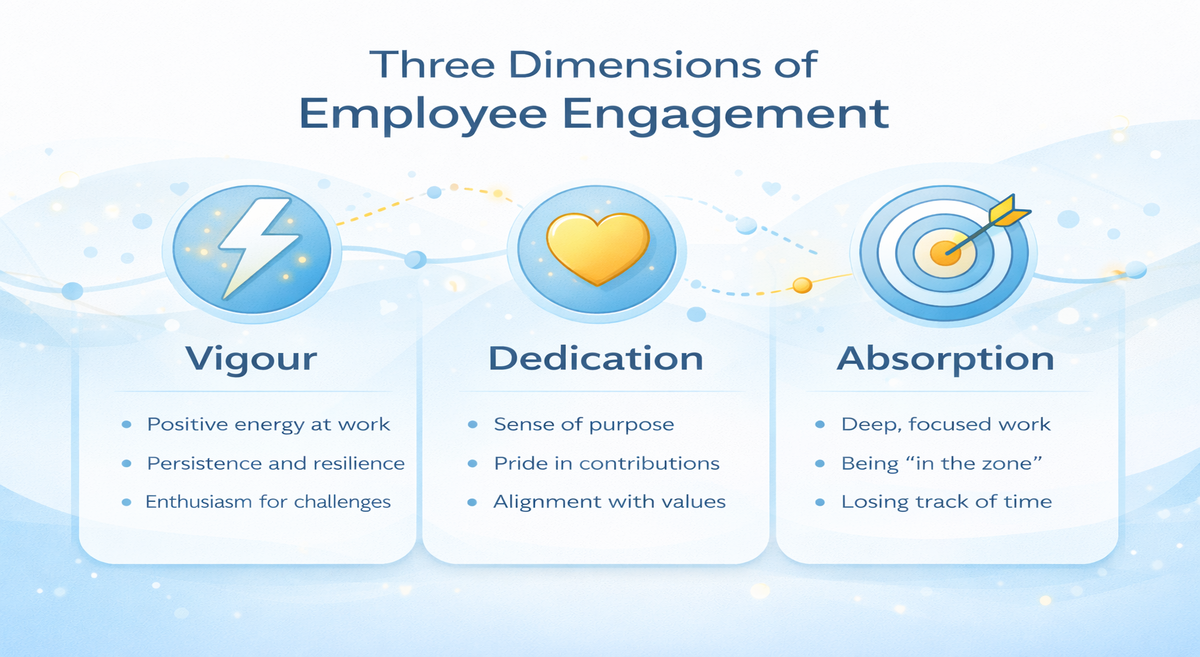
Research identifies three specific characteristics that define engagement in practice.
Vigor
Vigor refers to high levels of energy and mental resilience while working. Engaged employees bring sustained enthusiasm to their roles. They willingly invest effort even when work gets challenging.
This isn’t about working longer hours. It’s about the quality of energy people bring to their time at work. Vigour shows up as:
- Mental alertness and focus during tasks
- Persistence when facing obstacles
- Willingness to tackle difficult challenges
- Resilience when setbacks occur
People with high vigor don’t just push through their day. They actively engage with problems and opportunities as they arise.
Dedication
Dedication means being strongly involved in work and experiencing it as meaningful. Dedicated employees find purpose and significance in what they do. They feel proud of their contribution.
This dimension of engagement connects work to personal values and professional identity. Dedicated employees:
- View their work as meaningful beyond just earning money
- Feel proud of what their organization accomplishes
- Connect their role to larger purposes they care about
- Experience work as a source of professional fulfillment
Dedication transforms work from “just a job” into something that matters personally.
Absorption
Absorption describes being fully concentrated and engrossed in work. Time passes quickly. Focus comes naturally. Work captures full attention without feeling draining.
This is the “flow state” researchers describe when people lose themselves productively in their tasks. Absorbed employees:
- Concentrate deeply without constant distractions
- Find work naturally engaging rather than tedious
- Experience time passing quickly while working
- Feel energized rather than depleted by focused work
All three dimensions work together. Engagement isn’t just one of these characteristics. It’s the combination of vigor, dedication, and absorption that creates true engagement.
Why Employee Engagement Matters
Organizations with higher engagement levels consistently outperform those with lower engagement.
This advantage appears across productivity, retention, customer outcomes, and innovation.
Performance and productivity improve. Engaged employees don’t just complete assigned tasks. They find better ways to work, identify opportunities for improvement, and solve problems proactively. This drives measurably higher productivity than disengaged workers produce.
Retention increases significantly. Engaged employees don’t constantly search for other opportunities. They’re committed to their organization’s success and less likely to leave. This reduces turnover costs and preserves institutional knowledge.
Customer service strengthens. When employees care about outcomes, customers notice. Engaged workers provide better service because they’re genuinely invested in customer success, not just going through required motions.
Innovation happens more naturally. Engaged employees contribute ideas, spot opportunities, and suggest improvements. They care enough to think about how things could work better rather than just accepting how things are.
Organizational sustainability improves. Companies with engaged workforce adapt better to change, execute strategy more effectively, and build sustainable competitive advantages. Employee engagement becomes a strategic differentiator.
What Employee Engagement Is NOT
This is where many organizations get confused. Several things that seem like employee engagement actually aren’t.
Employee engagement is not employee satisfaction. Satisfied employees might be perfectly happy doing the minimum. They’re not dissatisfied, but they’re not investing discretionary effort either. Satisfaction is passive. Engagement is active.
Employee engagement is not just activities and perks. Fun Fridays, free snacks, game rooms, and social events can support engagement, but they don’t create it. These are nice additions, not the foundation. Organizations can have all these perks and still have deeply disengaged employees.
Employee engagement is not just about happiness. Happy employees might love their coworkers and enjoy coming to work without being engaged in the actual work itself. Engagement specifically involves connection to work purpose and outcomes.
Employee engagement is not something you do TO employees. It’s not a program you implement or an initiative you roll out. Real employee engagement emerges from conditions organizations create—conditions where people can be engaged. It’s something employees choose to give when the environment supports it.
Understanding these distinctions prevents wasting resources on surface-level activities that don’t address actual employee engagement drivers.
The Two-Way Nature of Engagement
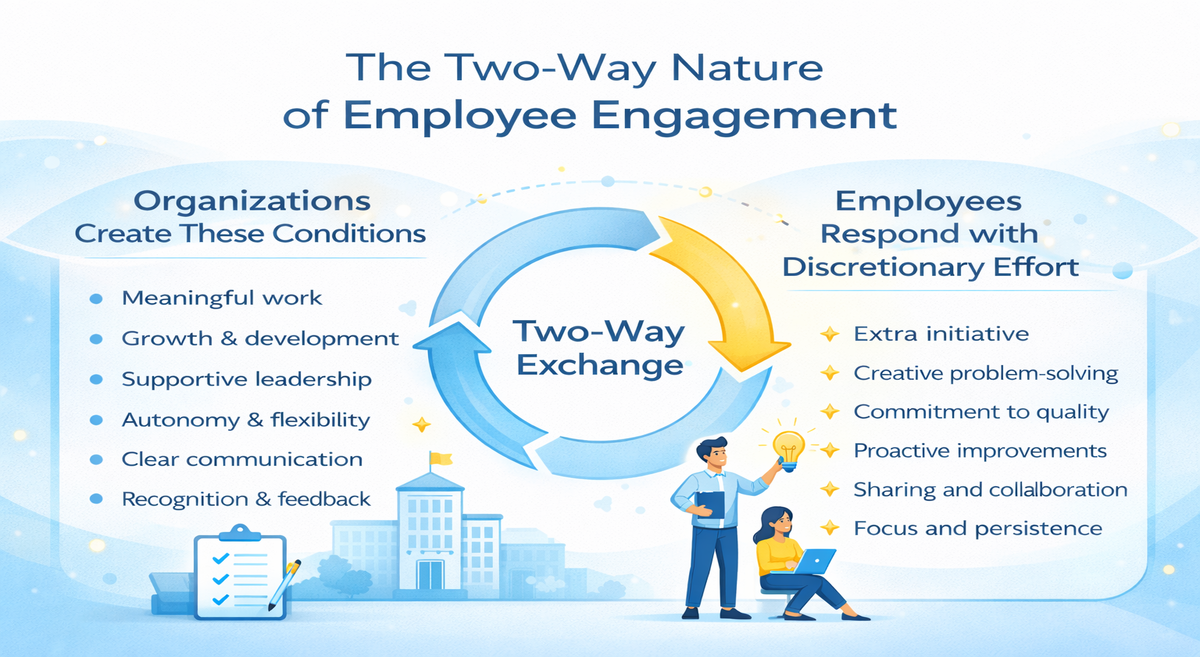
Here’s the critical insight many organizations miss: This practice is a two-way exchange, not something organizations demand from employees.
Organizations create conditions that make engagement possible. These include:
- Meaningful work that connects to larger purposes
- Autonomy in how people accomplish their responsibilities
- Opportunities for growth and development
- Supportive leadership that values contributions
- Clear communication about expectations and direction
- Recognition for achievements and efforts
When organizations provide these conditions, employees respond by freely offering discretionary effort—the extra initiative, creativity, and commitment that drives superior performance.
The key word is “freely”. You cannot mandate employee engagement. Employees choose to engage when the work environment makes engagement worth their investment.
Organizations that try to extract engagement through pressure or demands create the opposite effect. People disengage when they feel used rather than valued.
This two-way exchange distinguishes engagement from simple compliance. Compliance can be required. Engagement must be earned through creating environments where people want to invest themselves.
Engagement as Strategic Priority
Forward-thinking organizations treat employee engagement as a strategic priority, not an HR program. They recognize that workforce engagement directly impacts their ability to execute strategy, serve customers, and compete effectively.
Senior leadership ownership typically includes:
- Making engagement a board-level metric
- Embedding engagement measures into workforce planning
- Allocating resources through structured frameworks such as HCM 3000
Most importantly, all organizational stakeholders play roles in strengthening engagement; leaders who create supportive environments, managers who enable daily engagement, HR experts who design supportive systems, and employees themselves who choose to engage when conditions support it.
Within HCM 3000, employee engagement is governed as a structured workforce outcome aligned with ISO 23326, ensuring engagement data informs planning, risk, and sustainability decisions.
BPTW Best Place To Work® evaluates how consistently organizations apply these principles, moving engagement beyond activities into measurable human capital governance.
Images By: Chat GPT