Workforce Characterization: Defining Work and Workers

Matching the right people to the right work sounds simple. In practice, it’s impossible without clear definitions of what work requires and what workers can do.

Workforce characterization solves this problem. It’s the systematic process of defining work requirements and worker capabilities so organizations can make informed allocation and planning decisions.

Without this practice, resource decisions rely on informal knowledge, memory, and guesswork. With it, you have structured data that enables consistent, fair, and efficient matching of people to work.

What Workforce Characterization Actually Means

Workforce characterization encompasses two interconnected activities: defining work and defining workers.

Characterization specifies what needs to be done, when, where, and what capabilities are required. Worker characterization documents who is available, what they can do, and under what constraints they operate.

Together, these create the foundation for effective resource allocation, capacity planning, and workforce management. Organizations can’t optimize what they haven’t clearly defined.
Workforce Characterization : Three Approaches

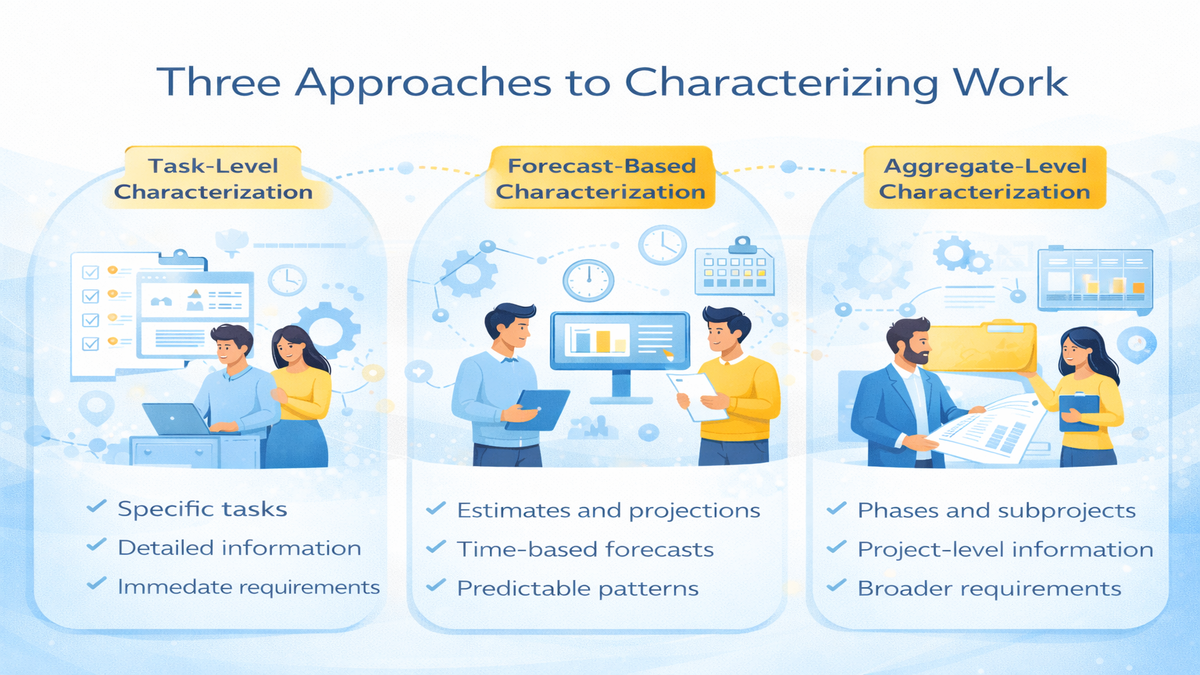
Three Approaches to Characterizing Work

Work can be defined at different levels depending on your needs and how much detail is known.

Task-Level Characterization

Tasks represent the lowest level of explicitly allocated work. Below task level, workers decide their own execution approach.

Tasks emerge from breaking down larger work (projects, phases, deliverables) or directly from business drivers. Train schedules create tasks for train drivers. Customer orders create tasks for delivery teams.

Task-level information includes:

  • Work name, description, and identifier
  • Start and finish timing (shifts, execution windows, immediate requirements)
  • Completion deadlines (milestones, due dates)
  • Required roles, skills, and proficiency levels
  • Demand quantified in hours or FTE
  • Location requirements (customer sites, delivery locations)
  • Physical requirements (mobility needs, physicality)

This detailed characterization of workforce enables precise matching of specific capabilities to specific requirements.

Forecast-Based Characterization

When specific tasks aren’t known in advance, work can be characterized through estimates and forecasts.

Call centers forecast call volumes by hour without knowing individual call details. Retail stores forecast customer traffic by day without knowing specific transactions.

Forecast information includes:

  • Time periods (hour, day, week)
  • Required roles, skills, and proficiencies
  • Demand expressed period-by-period in FTE, minutes, or hours
  • Relevant matching attributes (location, mobility, physicality)

This characterization approach suits predictable demand patterns where specific work details emerge later.

Aggregate-Level Characterization

Work can also be characterized above task level: subprojects, phases, deliverables, entire shifts.

Large projects might allocate resources at phase level rather than individual tasks. Operations might staff entire shifts rather than specific activities within those shifts.

Aggregate information includes:

  • Aggregate name, description, and identifier
  • Required roles, skills, and proficiencies
  • Demand appropriate for the aggregate level
  • Matching attributes applicable at this level

This supports characterization when detailed breakdown isn’t necessary or practical for decision-making.

Special Cases in Work Characterization

Some scenarios don’t fit standard workforce characterization patterns.

Unconstrained work exists when delivery time isn’t fixed or demand hasn’t been estimated. If managers are confident outcomes will be achieved, they can match work to workers using judgment rather than formal characterization.

A sales team with abundant opportunities might simply work through prospects in priority order. No need to characterize every potential sales conversation in advance.

Real-time business drivers require dynamic workforce characterization. Train schedules, delivery traffic, customer arrivals create work in real-time. Characterization must adapt to live information rather than advance planning.

This connects to broader workforce planning that determines overall capacity needs even when specific work characterization happens closer to execution.
Special Cases in Workforce Characterization

Characterizing Workers: Availability and Preferences

Effective characterization of workforce requires equally clear definition of worker attributes.

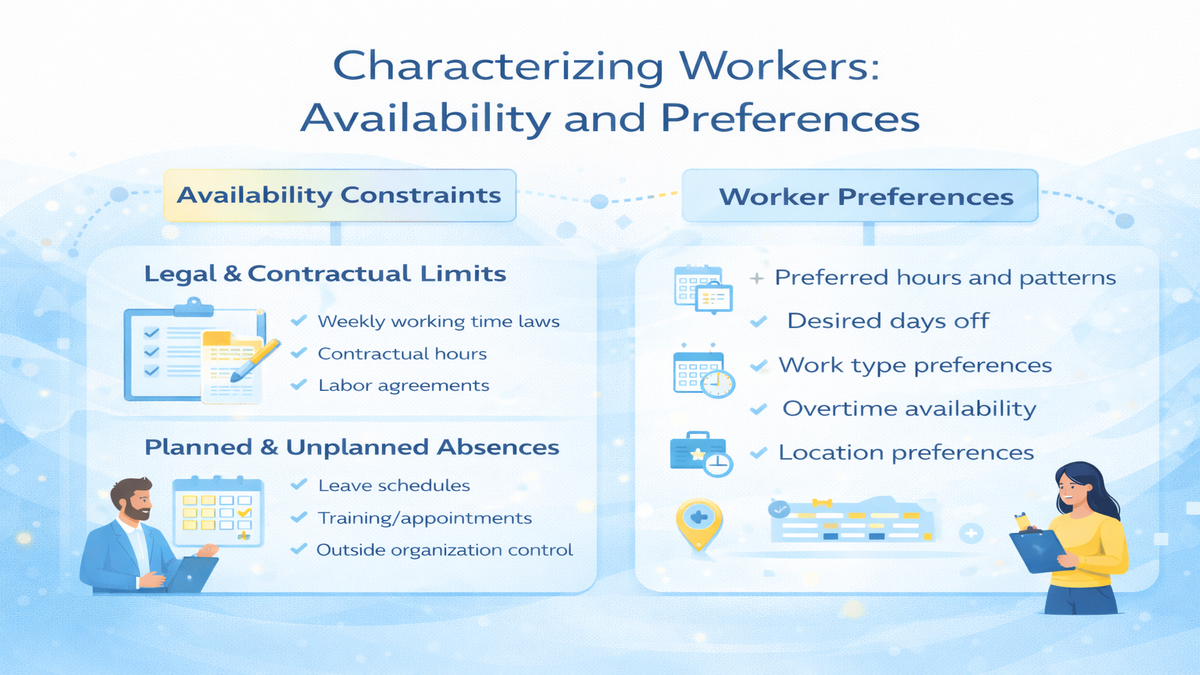
Availability Constraints

Worker availability is constrained by multiple factors that workforce characterization must capture:

Legal and contractual limits:

  • Maximum weekly working time laws
  • Employment contract specifications (full-time, part-time hours)
  • Labor agreements for contingent workers
  • Individual working time agreements

Planned and unplanned absences:

  • Annual leave schedules
  • Training commitments
  • Illness and medical appointments
  • Other absences outside organizational control

Flexibility elements:

  • Relief shift availability
  • Stand-by duty arrangements
  • On-call commitments

Availability information in workforce characterization doesn’t need more precision than work information. If work is planned weekly, hourly availability detail is unnecessary.

Previous allocations reduce actual availability. If someone is assigned 30 hours, they have less capacity remaining. Workforce characterization systems must track cumulative allocation.

Worker Preferences

Workers may indicate preferences that this practice should document:

  • Preferred working hours and patterns
  • Desired days off
  • Work type preferences
  • Overtime availability
  • Location preferences

Organizations decide which preferences influence allocation decisions. Not all preferences can drive assignments, but documenting them enables consideration where appropriate.

This aspect of workforce characterization supports positive candidate experience that extends beyond hiring into ongoing work assignment.

Characterizing Workers: Skills and Restrictions

Roles and Capabilities

Workers should be segmented by roles and skills in workforce characterization systems.

Within segments, differentiate further by:

  • Experience levels and tenure
  • Equipment and machinery knowledge
  • Proficiency or skill ratings
  • Past performance records
  • Required authorizations and certificates

This granularity enables workforce characterization that matches not just general skills but appropriate expertise levels to work complexity.

Restrictions and Accommodations

Some workers face restrictions that workforce characterization must document and respect.

Regulatory restrictions: Pregnant workers who cannot work irregular hours. Age restrictions for certain work types. Licensed requirements for specific activities.

Physical restrictions: Temporary or permanent limitations affecting mobility, lifting, sensory requirements, or cognitive demands.

Privacy and legal considerations: Data protection laws and labor agreements constrain what information can be collected and how it’s used in workforce characterization.

Collection and use of restriction information must be equitable, respectful, and privacy-compliant. Systems should enforce restrictions automatically rather than relying on manual oversight.

Location and Mobility in Workforce Characterization

Geographic factors often matter for matching work to workers.

Document workers’ base locations, current locations (for mobile workers), and mobility capabilities (willingness and ability to travel).

Match location requirements in work characterization to location attributes in worker profiles. Don’t assign site work to workers without transportation. Don’t assign travel to workers with mobility constraints.

Capturing Additional Attributes

Specific contexts may require additional workforce characterization beyond standard categories.

Airport security might need gender diversity for screening. Customer-facing work might need language capabilities. Sensitive projects might require security clearances.

Capture attributes needed for your workforce characterization decisions, but avoid collecting unnecessary data that creates privacy concerns without adding value.

Making Workforce Characterization Practical

Effective workforce characterization balances comprehensiveness with practicality.

Start with essential attributes. Don’t characterize everything theoretically possible. Focus on factors that actually drive allocation and planning decisions in your organization.

Maintain current information. Workforce characterization loses value when data becomes stale. Update availability, skills, and preferences as changes occur.

Respect privacy and fairness. Collect and use worker information equitably. Ensure workforce characterization doesn’t enable discriminatory decisions.

Enable self-service where appropriate. Let workers update their own preferences, availability, and certain attributes rather than requiring manual data entry by administrators.

This systematic approach supports comprehensive workforce allocation that treats resource distribution as strategic capability.

Conclusion

Workforce characterization transforms resource management from informal knowledge into structured capability.

Organizations that clearly define work requirements and worker attributes make consistently better allocation and planning decisions. They match skills to needs accurately, respect constraints, and optimize utilization.

Start by determining what level of work characterization serves your needs: tasks, forecasts, or aggregates. Then document worker attributes that matter: availability, skills, restrictions, and preferences.

With clear workforce characterization, resource decisions become systematic, fair, and effective rather than subjective and inconsistent.

Images by : Chat GPT

Ready to implement structured workforce characterization as part of comprehensive human capital management? Learn how BPTW certification provides frameworks for systematic people management.

Workforce Planning: Why It Matters for Business Success

Understanding workforce planning has become critical for organizational success. Workforce planning identifies your current workforce capabilities, projects future needs, and calculates the gap between them. This discipline ensures organizations have the right people with the right skills when they’re needed.

Within structured human capital frameworks such as HCM 3000, this process is governed as a strategic management discipline rather than a reactive HR activity.

International guidance such as ISO 30409 (Human resource management — Workforce planning) reinforces the need to systematically link workforce capability planning with organizational strategy and risk management.

Two dimensions of workforce planning

The Two Dimensions of Workforce Planning

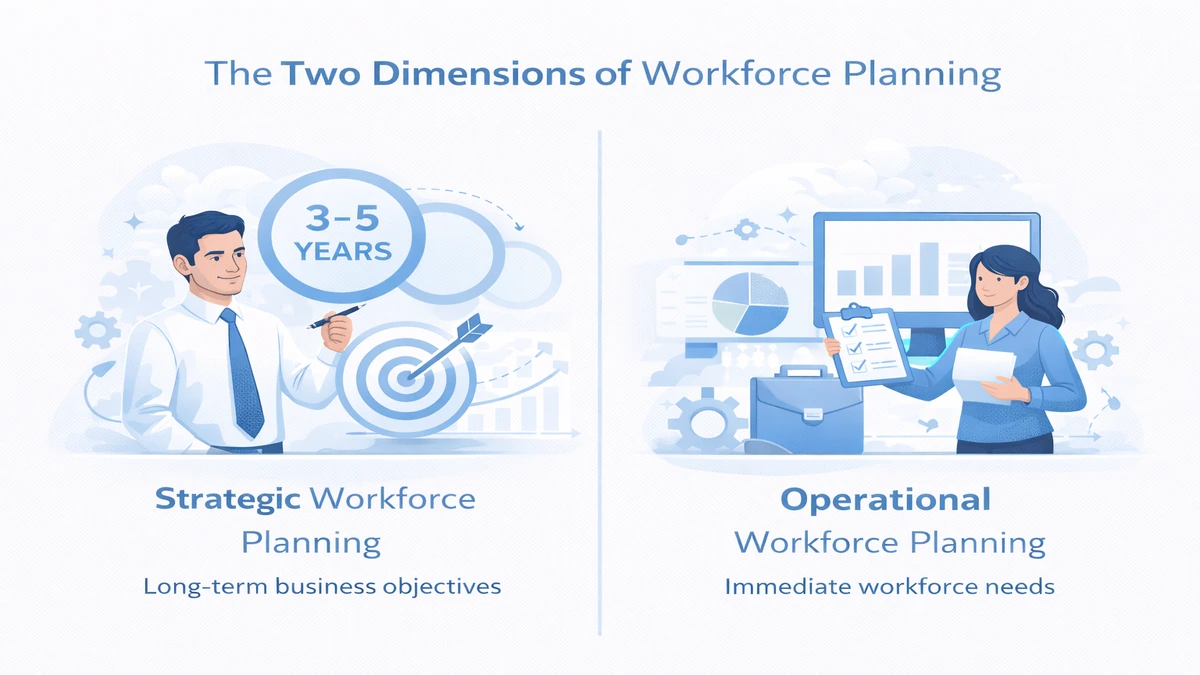
Workforce planning operates at two distinct levels, each serving different organizational needs.

Strategic workforce planning looks three to five years ahead. It aligns talent requirements with long-term business objectives, anticipating how growth, technological advancement, and market evolution will reshape workforce needs. This includes succession planning for critical roles and leadership development programs.

Operational workforce planning addresses immediate requirements. It monitors workforce metrics such as turnover rates, productivity levels, and employee satisfaction. Adjustments happen based on operational demands, seasonal fluctuations, and current business conditions.

Both dimensions are necessary. Strategic planning without operational execution remains theoretical. Operational focus without strategic direction becomes reactive firefighting.

Why This Capability Can’t Be Ignored

The global business environment is increasingly complex and interconnected. Markets shift rapidly. Technology evolves continuously. Workforce demographics are transforming. Organizations need planning to navigate this complexity effectively.

The value of structured capability planning becomes clear when organizations face these dynamic challenges. Without structured workforce planning, businesses struggle to adapt quickly enough to remain competitive.

Planning connects human resource strategy to business strategy and financial plans. When your organization pursues new markets, adopts new technologies, or shifts strategic direction, workforce planning identifies the talent implications early. This visibility enables proactive responses through hiring, training, internal mobility, or restructuring.

The Business Case for Planning

Organizations without a structured planning framework encounter consistent problems. Critical positions remain vacant because succession plans don’t exist. Skill gaps surface unexpectedly when new initiatives launch. Training investments lack strategic direction. Hiring happens reactively under pressure, which increases costs and reduces quality.

These issues impact financial performance and operational effectiveness. Vacancies reduce productivity. Poor talent utilization wastes compensation investment. High turnover from inadequate development opportunities creates constant replacement costs.

Planning Through Organizational Change

This planning discipline becomes particularly valuable during significant organizational transitions. Growth requires different capabilities than maintenance. Restructuring demands a clear understanding of required versus available skills. Mergers and acquisitions involve integrating workforce with different profiles. Di-vestments require determining which capabilities to retain.

Planning helps organizations understand the workforce implications of business decisions before commitments are made, not after problems emerge.

what makes workforce planning

What Makes This Planning Effective

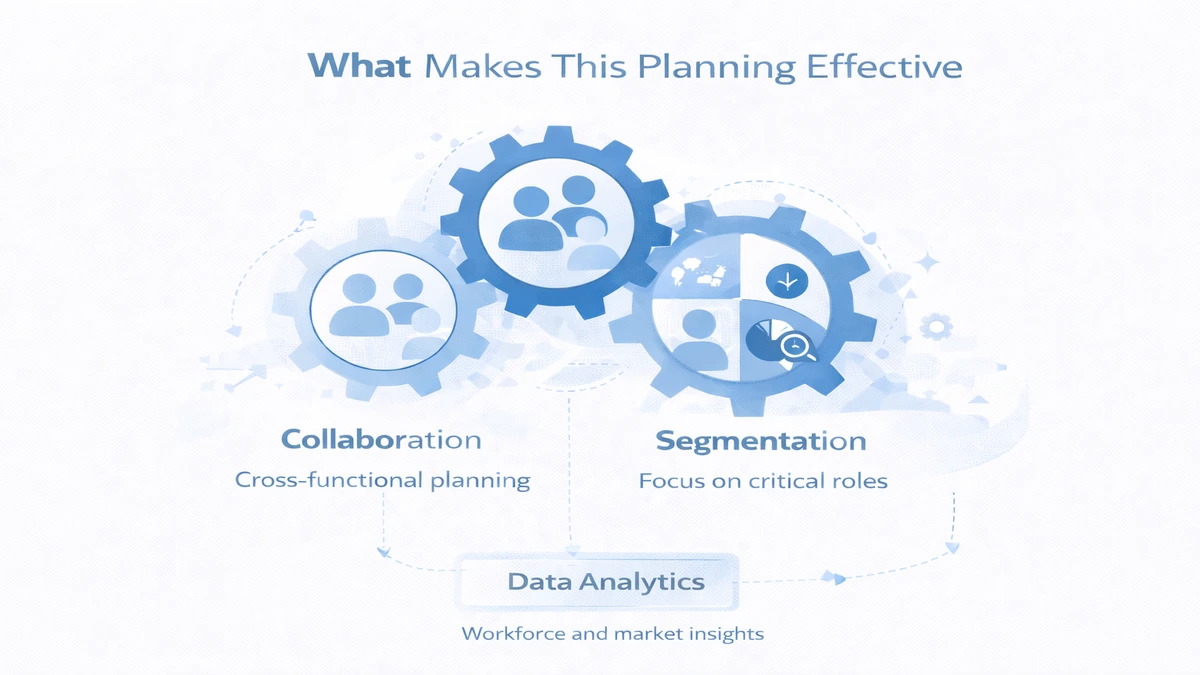
Effective planning requires collaboration across functions. HR brings workforce data and people expertise. Business leaders provide strategic direction. Finance contributes budget parameters. Department heads understand operational requirements.

This collaboration ensures plans reflect actual business needs rather than isolated functional perspectives.

Planning also depends on quality data. Workforce analytics reveal patterns in turnover, performance, and skill distribution. Skill inventories identify current capabilities. Market intelligence shows external talent availability. These inputs produce realistic projections about future needs and how to address them.

Segmentation improves planning effectiveness. Strategic roles that directly drive business success warrant more intensive planning focus than support functions. Understanding which roles are critical, which skills transfer across positions, and where talent bottlenecks exist enables smarter resource allocation.

Within HCM 3000, workforce planning requires organizations to identify critical roles, future capability needs, and workforce risks as part of structured human capital governance.

This aligns directly with ISO 30409, which emphasizes scenario-based workforce planning, role criticality assessment, and capability gap analysis rather than simple headcount forecasting.

Building Organizational Capability

This capability transforms how organizations approach their most significant asset. Instead of reacting to immediate staffing pressures, planning enables deliberate capability building aligned with business direction.

Organizations with mature planning adapt more effectively to changing conditions. They’ve considered potential scenarios, understood workforce implications, and prepared response options. When market conditions shift or strategic priorities change, execution happens more smoothly because the workforce side supports rather than constrains performance.

This capability becomes increasingly valuable as business environments grow more dynamic and competitive pressures intensify.

Workforce Planning: The Foundation for Resilience

This approach creates organizational resilience by making workforce requirements explicit and actionable. It reduces vulnerability to key person dependencies, skill shortages, and demographic shifts.

Planning also improves decision quality. When workforce implications are visible during strategy development, leaders make more informed choices about timing, resource allocation, and risk management.

The result is an organization better positioned to execute its strategy with confidence that workforce capability will support business objectives.

BPTW Best Place To Work® certification evaluates how consistently organizations apply workforce planning as part of structured human capital governance, not as an isolated HR exercise.

Assessment focuses on whether workforce planning outputs inform leadership decisions, capability investment, succession planning, and long-term organizational sustainability rather than remaining theoretical documents.

Image source: Illustrative visual for workforce planning concepts

Workforce Allocation: Preventing Common Problems

Every manager has faced this: some team members are drowning in work while others don’t have enough to fill their day. Projects slip. Budgets blow out. Good people burn out and leave.

The problem isn’t your people. It’s workforce allocation. Getting the right work to the right people at the right time sounds simple but rarely is. Most organizations only react after problems appear. The smarter approach is preventing them.

Recognizing Workforce Allocation Problems

Several warning signs indicate allocation issues need attention:

Team members in the same department have drastically different workloads. One person is overloaded while another is underutilized, creating inefficiency and frustration.

A team has insufficient capacity for assigned work. Deadlines slip, quality suffers, and burnout risk increases.

A team has excess capacity relative to available work. Utilization drops below targets and resources are wasted.

Different teams face opposite problems. One department drowns in work while another has excess capacity, despite needing similar skills.

Effects of poor workforce allocation

Nine Workforce Allocation Actions

Match these actions to your specific situation. Start with simpler solutions before implementing major changes.

1. Redistribute Work Between Team Members

When some workers are overallocated while others are underutilized within the same team, move work from overloaded people to those with available capacity.

This requires clear visibility into who actually has bandwidth. Without it, a developer might work weekends while another team member operates at 50% capacity.

This works when underutilized people possess the skills needed for redistributed work.

2. Split Work Between Multiple People

Assign more than one person to work on the same activity when work items are too large for one person or to spread knowledge across the team.

A complex client implementation might overwhelm one project manager. Assigning senior and junior project managers together shares the load, reduces risk, and builds capability.

3. Increase Working Hours Within Limits

When a team faces temporary work surges, increase allocated working hours through overtime or flexible scheduling within legal and policy limits.

Accounting teams working extended hours during tax season is appropriate because it’s predictable and temporary. The key word is temporary—sustained overtime leads to burnout and declining productivity.

4. Reduce Working Hours

When a team has less work than capacity and utilization drops below targets, reduce allocated hours to match actual work available.

Customer support teams experiencing seasonal summer volume drops can adjust schedules rather than paying for unused capacity. This works when lower demand is temporary and you want to retain the team.

5. Share Work and Workers Between Teams

When some teams have surplus capacity while others with similar skill requirements face deficits, temporarily move work or workers between teams.

If marketing has excess design capacity while product desperately needs design support, temporarily assign a designer to help the product team. This requires coordination and managers willing to prioritize overall organizational success.

6. Reduce Total Work Demand

When a team faces persistent deficit even after trying actions 1-5, reduce the total work the team must complete by cutting low-priority activities or slowing delivery timelines.

If your development team is consistently overallocated, you might be building too many features simultaneously. Defer lower-priority features to match team capacity.

7. Increase Capacity by Adding Workers

When a team has persistent deficit that redistribution can’t resolve, and the work demand is both necessary and sustainable, recruit new employees or engage contractors.

If your sales team grows faster than implementation can handle, and the work is profitable and ongoing, hire additional implementation specialists.

This action has the longest timeline and highest cost, so ensure demand is lasting before committing.

8. Increase Demand for Surplus Capacity

When a team has persistent surplus capacity and you want to keep the team together, find or create additional work that productively uses available capacity.

If your IT infrastructure team automated many routine tasks creating excess capacity, use that capacity for infrastructure improvements you’ve postponed.

9. Reduce Capacity

When a team has persistent surplus capacity and lower demand is permanent, reduce total capacity through furloughs, layoffs, or ending contractor relationships.

If your organization shifted from on-premise to cloud-based software, the installation team faces permanently reduced demand. Reduce team size to match the new reality.

Choosing the Right Action

These actions follow a progression. Actions 1-5 redistribute existing work and capacity. They’re quick and low-cost. Start here.

Actions 6-9 change total demand or capacity. They take longer, cost more, and have bigger impact. Only use these when redistribution doesn’t work.

Context matters. A temporary surge needs a different response than permanent demand change. Skills that exist elsewhere enable different solutions than skills you don’t have anywhere.

Making Workforce Allocation Work

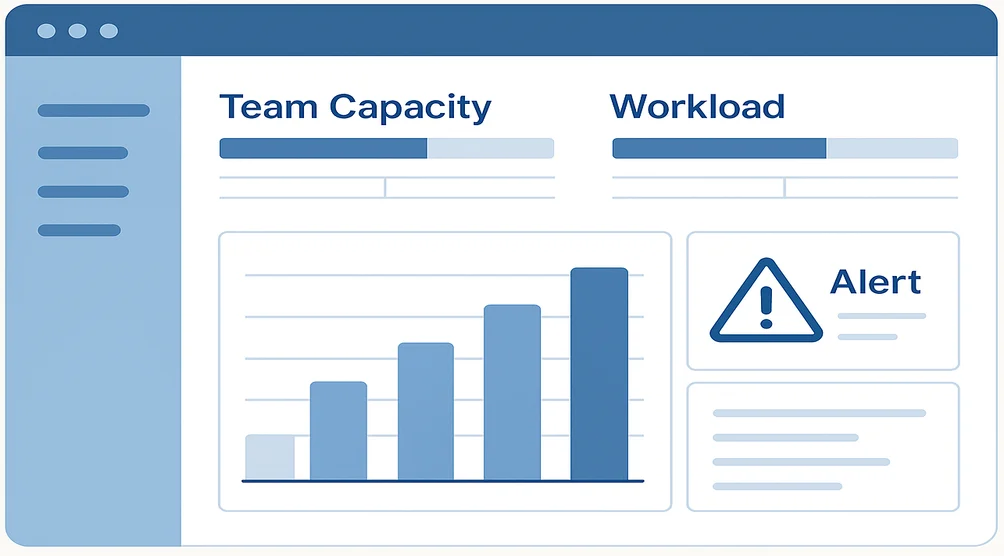
Effective workforce allocation requires visibility into who has capacity, who’s overloaded, and where work accumulates. Create simple tracking mechanisms. A spreadsheet showing allocated versus available hours works fine.

Review allocation regularly. Monthly reviews work for most situations, weekly for fast-moving environments. Empower managers to redistribute work, adjust schedules, or request help without elaborate approval processes.

Communicate transparently when increasing hours, moving people between teams, or reducing capacity. People accept difficult decisions more easily when they understand the reasoning.

The Bottom Line

Workforce allocation problems are normal as demand fluctuates and circumstances change. The difference between organizations that handle this well and those that struggle isn’t whether problems occur—it’s whether they identify and address issues before they escalate.

Start with visibility into allocation across your organization. Establish regular reviews. Give managers clear actions based on specific circumstances. The goal is identifying problems early and taking appropriate action before they damage performance.

Images created by : Chat GPT

Need systematic approaches to workforce allocation? Learn how BPTW Certification provides practical frameworks for managing capacity and workload effectively.

Workforce Segmentation: Identify Critical Roles and Skills

Your organizational chart shows who reports to whom. But does it show which roles drive revenue, which skills are scarce, or where critical capability gaps exist?

Probably not. That is where workforce segmentation changes everything.

Workforce segmentation classifies roles, functions, and competencies strategically so organizations can identify which positions matter most and plan talent decisions accordingly.

Why Workforce Segmentation Matters

Not all jobs contribute equally to success. Some roles directly generate revenue. Others keep critical operations running. Some require rare skills that take years to develop.

Without workforce segmentation, you spread resources too thin. You invest equally in everything instead of focusing where it counts.

The reality is stark:

  • Sales and engineering drive different value
  • Support roles need different planning than strategic roles
  • Geographic location affects talent availability
  • Skills shortages appear in specific areas, not everywhere

Workforce segmentation reveals these patterns. It enables targeted workforce planning, smarter hiring, and efficient resource allocation.

Workforce Segmentation as a Governance Requirement

Within structured frameworks such as HCM 3000 and ISO 30409, workforce segmentation supports disciplined workforce planning, role criticality assessment, and allocation decisions. It ensures organizations focus investment on roles and capabilities that materially impact performance, continuity, and risk.

Organizations certified by BPTW Best Place To Work® are assessed on how systematically these workforce planning and segmentation practices are embedded and maintained.

Two Basic Segmentation Approaches

Organizations segment workforce in two fundamental ways:

1. Role-Based Segmentation

This groups jobs by the value they create or work they perform.

Key questions answered:

  • What work drives business results?
  • Which roles create the most value?
  • What skills does each position require?
  • How many people do we need in each category?

Role-based workforce segmentation focuses on positions, not the individuals filling them. It connects directly to business needs and strategy.

2. Employee-Based Segmentation

This groups people by demographic characteristics or observable traits.

Common segmentation factors:

  • Age and generational cohorts
  • Tenure and experience levels
  • Geographic location
  • Education and certifications
  • Performance ratings

Employee-based workforce segmentation helps understand your current talent pool composition and identify retention risks.

Most organizations use both approaches for different purposes. Neither is wrong—they answer different strategic questions.

4 levels workforce segmentation

Four Workforce Segmentation Methods

Organizations typically progress through increasingly sophisticated approaches as planning capabilities mature.

Level 1: Organizational Structure (Low Maturity)

The organisation chart represents the most basic segmentation. It groups positions by reporting lines and departments.

Advantages:

  • Everyone understands it
  • Already exists in every organization
  • Easy to create and update

Limitations:

  • Shows hierarchy, not capabilities
  • Groups by function, not skills
  • Reveals nothing about geographic distribution
  • Doesn’t identify critical roles

Organizations using only this struggle with meaningful workforce analysis. They know who reports to whom but not where capability gaps exist.

Level 2: Geographic Segmentation (Low Maturity)

Segmenting by location shows employee distribution across regions or sites.

When this helps:

  • Understanding workforce concentration risks
  • Assessing local labor market conditions
  • Planning facility expansions or closures
  • Managing distributed teams

The limitation: Geography alone doesn’t reveal skills, competencies, or role criticality. It works best combined with other workforce segmentation types.

Level 3: Job Family Model (Medium Maturity)

Job families group similar occupational roles based on related competencies.

Example job families:

  • Sales and Business Development
  • Engineering and Product Development
  • Operations and Supply Chain
  • Finance and Accounting
  • Administration and Facilities

Within each family, roles require similar skill types and knowledge domains.

Why this matters: Job family workforce segmentation enables integration with external labor market data. You can compare your workforce composition to broader market trends and availability.

Level 4: Systematic Segmentation with Criticality (High Maturity)

The most effective workforce segmentation identifies specific skills needed within job groups and assesses role criticality.

This answers:

  • Exactly which capabilities exist versus which we need
  • Where precise skill gaps exist
  • Which roles are most critical to success
  • How to prioritize development and recruitment

Instead of knowing “we need engineers,” systematic workforce segmentation reveals “we need engineers with cloud architecture skills, machine learning expertise, and experience with scalable systems.”

Criticality assessment evaluates:

  • Impact on financial performance
  • Delivery of essential services
  • New product and service development
  • Strategic project completion
  • Organizational management effectiveness

Critical roles receive priority in succession planning, compensation strategy, and development investment.

This structured approach aligns with international workforce planning guidance such as ISO 30409, which emphasizes linking future capability needs to organizational strategy.

The Job Hierarchy Framework

Effective workforce segmentation uses a practical four-level hierarchy:

  1. Job Family The highest grouping of similar jobs. Example: Administration, Facilities and Property
  2. Job Function A subgroup requiring similar skills within the family. Example: Executive Assistants, Secretaries and Receptionists
  3. Job Role Specific positions within the function. Example: Personal/Executive Assistants
  4. Competencies Knowledge, skills, experience, and attitudes required. Example: Calendar management, executive communication, confidentiality, stakeholder coordination

This layered workforce segmentation approach supports job profiling and reveals where competencies transfer across different roles.

Practical application of workforce segmentation

Practical Applications

Effective workforce segmentation enables several strategic benefits:

Focus planning efforts Concentrate on critical job families first instead of trying to plan for everyone simultaneously.

Identify skill gaps precisely Understanding competency requirements by segment reveals exactly where capabilities are lacking.

Support succession planning Prioritize development pipelines for roles identified as most critical through workforce segmentation.

Inform recruitment strategy Know which roles to fill externally versus develop internally based on market availability and internal capability.

Enable scenario planning Test different workforce scenarios based on business changes using your workforce segmentation framework.

Getting Started

Start simple with workforce segmentation. Build sophistication over time as needs and capabilities grow.

Practical first steps:

  • Begin with existing org structure and add layers
  • Define clear criteria for each segment
  • Engage managers who understand roles best
  • Document the framework with clear definitions
  • Review and update quarterly as business evolves

Use workforce segmentation for actual decisions. The framework only adds value when it informs real workforce planning and resource allocation.

Workforce segmentation is evaluated within BPTW certification as part of structured workforce planning and human capital management under HCM 3000, ensuring decisions are evidence-based rather than ad hoc.

Image Credit : Storyset & Chat GPT

Workforce Planning for Small Organizations: A Practical 5-Step Strategy

Running a small organization means every hiring decision carries weight. There is no excess capacity to absorb mistakes, no long bench to cover skill gaps, and no room for guesswork when people leave or roles change.

Yet workforce planning for small organizations is often ignored or postponed, treated as something only large enterprises with complex HR functions need. That assumption is costly. In reality, smaller organizations are more exposed to workforce risks, not less.

Workforce planning is not about prediction or bureaucracy. It is about making deliberate decisions so your business strategy can actually be executed by the people you have, and the people you will need.

When done properly, workforce planning connects business direction, capability requirements, and people decisions into one coherent process.

This article explains how workforce planning for small organizations can be applied practically without complex systems or large HR teams.

Why Workforce Planning for Small Organizations Matters

In a small organization, the loss of a single key employee can stall delivery, damage customer relationships, or halt growth plans entirely. A single poor hire can absorb management time for months and create downstream performance issues.

Without workforce planning, organizations operate in reactive mode:

  • Hiring happens only after problems appear

  • Skill gaps are discovered when it is already too late

  • Growth plans assume people capacity that does not exist

Workforce planning for small organizations creates visibility. It forces leaders to confront whether their current workforce can support future ambitions, rather than assuming it will somehow work out.

This is not about building complex forecasts. It is about asking the right questions early enough to act.

Workforce Planning for Small Organizations as a Structured Management Process

Workforce planning works best when it is treated as part of a broader people management system, not as a one-off HR exercise. Under structured frameworks such as HCM 3000, and ISO 30409 workforce planning is evaluated as a governance activity that links strategy, capability, and performance.

The emphasis is on consistency, accountability, and evidence-based decision-making. Planning is not separated from recruitment, development, or workforce allocation. It informs all of them.

For small organizations, this structure brings clarity. It replaces informal assumptions with shared understanding across leadership.

steps of workforce planning in small organisation

The 5-Step Workforce Planning Strategy That Works

This five-step approach is deliberately practical. It scales easily and does not require specialist software or large HR teams. What it does require is leadership involvement and honest analysis.

Step 1: Identify Strategic Issues That Affect Your Workforce

Workforce planning starts with strategy, not headcount.

Leaders must first understand how the organization’s strategic direction will affect how work is done. This includes growth plans, market changes, technology adoption, or shifts in operating models.

Each leader should ask:

  • What will change in how we deliver value?

  • What new demands will this place on our teams?

  • Which parts of the organization will be most affected?

For example, a small software company shifting from product sales to solution delivery will experience very different workforce impacts across development, sales, and customer support.

This step ensures workforce planning is grounded in reality, not abstract HR assumptions.

Step 2: Define the Skills and Capabilities Required

Once strategic issues are clear, the next step is defining what capabilities are required to support them.

This includes both technical skills and behavioral competencies. In workforce planning for small organizations, this clarity prevents over hiring and under utilization. It also includes understanding quantity, not just quality.

Key considerations include:

  • Which skills become critical for future success?

  • Which capabilities will increase in importance?

  • Which existing skills may become less relevant?

  • How many people are realistically needed in each area?

At this stage, precision matters. Vague statements about “better communication” or “more agility” are not enough. Capabilities must be defined in ways that can later be assessed, developed, or recruited.

Step 3: Analyze Your Current Workforce Honestly

This step examines what already exists.

Organizations often rely on job titles or outdated job descriptions, which rarely reflect reality. Workforce planning requires an honest assessment of actual skills, experience, and role coverage.

Effective approaches include:

  • Reviewing what work is actually being performed

  • Mapping employee skills beyond formal roles

  • Identifying underused or hidden capabilities

For small organizations, this process often reveals surprises. Employees may have experience or strengths that are not being leveraged, while some roles may have drifted far from their original intent.

Documenting this “as-is” state creates a baseline for meaningful planning.

Step 4: Identify Capability Gaps and Risks

This comparison is a core control point in workforce planning for small organizations.

These gaps typically fall into three categories:

  • Shortages: Capabilities the organization lacks and must acquire

  • Surpluses: Skills that may become less relevant over time

  • Misalignment: Roles that need to evolve significantly

This step also surfaces workforce risks. Dependency on a single individual, lack of succession options, or concentration of critical knowledge are all risks that small organizations cannot afford to ignore.

Under structured human capital management, these risks are evaluated deliberately, not discovered accidentally.

Step 5: Build a Practical Implementation Plan

Planning only matters if it leads to action.

The final step is converting insights into a realistic implementation plan that covers recruitment, development, and structural changes.

A balanced plan typically includes:

  • Recruitment actions for capabilities that cannot be developed internally

  • Development plans for employees who can grow into future roles

  • Role adjustments or redeployment where skills are becoming obsolete

For example, an organization might combine targeted external hiring with focused development of existing staff, rather than defaulting to replacement hiring.

This implementation plan becomes the reference point for workforce decisions over the next planning cycle.

Why This Approach Works for Small Organizations

Workforce planning for small organizations succeeds when it is:

  • Simple enough to maintain

  • Structured enough to guide decisions

  • Integrated with how the organization actually operates

This five-step approach avoids unnecessary complexity while preserving discipline. It aligns people decisions with strategy, rather than reacting to events.

Within frameworks such as HCM 3000, and ISO 30409 this disciplined approach supports governance, accountability, and long-term sustainability, without burdening organizations with excessive documentation.

Making Workforce Planning Sustainable

Workforce planning is not a one-time exercise. It should be reviewed regularly and adjusted as conditions change.

Practical ways to sustain it include:

  • Reviewing plans quarterly or biannually

  • Updating assumptions when strategy shifts

  • Involving managers consistently, not occasionally

For small organizations, consistency matters more than perfection. A simple process followed consistently will outperform a complex process that is ignored.

Final Thoughts

Workforce planning is not about predicting the future. It is about being prepared for it.

For small organizations, the cost of avoiding workforce planning for small organizations is far higher than the effort required to plan. By connecting strategy, capability, and people decisions, workforce planning enables organizations to grow deliberately rather than re-actively.

When approached as a structured management process, workforce planning becomes a leadership tool, not an HR formality. It ensures that when opportunities or challenges arise, the organization has the people capacity to respond.

That is not optional. That is operational reality.

Upcoming Webinar : Learn About BPTW – Best Place to Work

Join our upcoming webinar to learn how BPTW certification can help your organization build structured people systems that drive business success.

Date:

10th september 2025

Time:

4.00 PM - 4.30PM IST