Employer Brand and Recruitment: Why Your Reputation Matters

Your employer brand is your reputation as a place to work. It’s what people say about you when you’re not in the room. And it directly determines how easy or hard recruitment becomes.

Organizations with a strong, positive reputation as an employer attract talent easily. Organizations with weak or negative brands struggle to fill positions, even when offering competitive compensation. The difference isn’t just about difficulty. It’s about cost, time, and the quality of people you can ultimately hire.

What Is Employer Brand?

Employer brand encompasses the functional, economic, and psychological benefits that employees or prospective employees associate with working for your organization.

It includes:

Functional benefits: What the job actually involves, career development opportunities, work-life balance, and working environment.

Economic benefits: Compensation, benefits, job security, and financial stability of the organization.

Psychological benefits: Organizational culture, sense of purpose, social responsibility commitments, reputation, and how people feel about working there.

Your employer brand influences and is influenced by nearly all your HR practices. How you recruit, develop, manage performance, and treat departing employees all contribute to your reputation.

Within structured human capital frameworks such as HCM 3000, employer brand is treated as a recruitment system outcome, not a marketing asset. International guidance like ISO 30405 (Human resource management — Recruitment) reinforces the role of employer brand in attracting, assessing, and selecting suitable talent consistently.

Three Levels of Employer Brand Strength

Employer reputation as a place to work exists on a spectrum. Understanding where you sit helps determine what you need to improve.

Level 1: Awareness Have potential employees heard of your organization?

If people don’t know you exist, you’re starting from scratch with every recruitment effort. You’ll spend significant resources just getting noticed.

Level 2: Consideration Would potential employees consider working for you?

Awareness isn’t enough. People know many organizations they’d never want to work for. At this level, your organization makes people’s shortlist of potential employers.

Level 3: Preference Would potential employees rank you above other potential employers?

This is an employer of choice territory. When candidates have multiple offers, they choose you. When talented people think about changing jobs, they reach out to you first.

Moving up these levels dramatically changes recruitment dynamics. The higher your brand strength, the larger your applicant pool, the better the quality of candidates, and the fewer resources needed to fill positions.

Building Employer Brand Into Recruitment

BPTW Best Place To Work® certification evaluates whether employer brand is supported by consistent employee experience, leadership behavior, and recruitment outcomes rather than standalone messaging. The focus is on alignment between promise and reality.

Your employer brand should be visible throughout your recruitment process, not just mentioned in job ads.

Gather your existing materials. Collect current external communications including designs, logos, slogans, and phrases. Consistency matters. Your recruitment messages should align with your broader organizational messaging.

Identify cultural positives. What’s genuinely good about working at your organization? Don’t make things up. Identify authentic positives you can communicate honestly.

Understand external perceptions. What do customers, community members, and other stakeholders think about your organization? These perceptions influence whether people want to work for you.

Clarify leadership vision and values. What does leadership stand for? What matters to them? People increasingly want to work for organizations whose values align with their own.

Provide realistic job information. Overselling jobs backfires. People who join based on inflated promises leave quickly when reality doesn’t match expectations. Be honest about both positives and challenges.

Highlight unique positioning. What makes your organization different as an employer? What can you offer that others can’t or don’t?

Ensure message consistency. Your recruitment messages must not contradict messages from other parts of the organization. In fact, they should reinforce them. Contradictions destroy credibility.

Develop a deployment plan. How will you communicate your employer brand to target candidates? Through social media, marketing channels, public relations, employee testimonials, or direct outreach? Map out your approach by channel and audience.
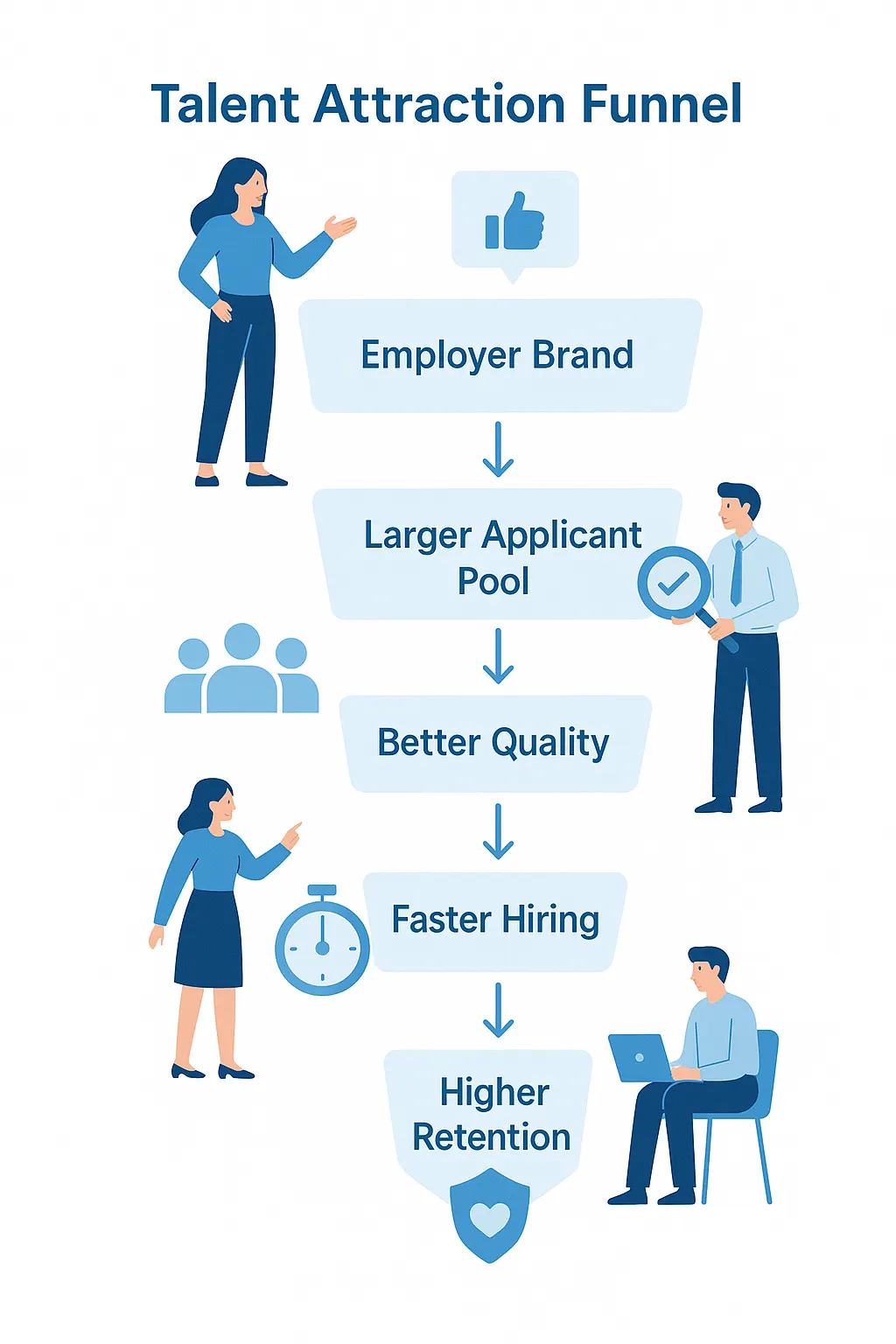
Employer brand Talent attraction funnel

Measuring Employer Brand Impact on Recruitment

You can’t improve what you don’t measure. Track metrics that reveal employer brand strength and its effect on recruitment outcomes.

1.  Volume metrics:

  • Total number of applicants per vacancy
  • Number of unsolicited applications
  • Number of employee referrals per vacancy

Strong employer brands generate more applications with less effort, including people proactively reaching out.

2. Quality metrics:

  • Percentage of applicants meeting or exceeding job requirements
  • Percentage of applicants advancing to candidate pools
  • Job offer acceptance rate

Strong brands attract better-qualified candidates who are more likely to accept offers.

3. Efficiency metrics:

  • Average time to fill vacancies
  • Cost per hire
  • Percentage of candidates who show up on their scheduled start date

Strong brands fill positions faster and more cost-effectively with fewer no-shows.

4. Retention metrics:

  • Six-month and one-year retention rates for new hires
  • Number of new employees promoted within typical time-frames

Strong brands attract people who stay and succeed, not just people who accept any job offer.

5. Perception metrics:

  • Survey applicants about how employer brand influenced their decision to apply
  • Survey candidates who rejected offers about why they chose differently

Direct feedback reveals whether your employer brand messaging resonates and where it falls short.

Compare these metrics against industry benchmarks. Good or bad is relative. What matters is how you perform compared to organizations competing for the same talent.

The Foundation: Corporate Brand

Difficult truth: you can’t build a strong employer brand without a solid corporate brand.

If your organization has a weak or negative reputation in the marketplace, that perception spills over into recruitment. People don’t compartmentalize. They don’t think “this company has terrible products and treats customers poorly, but I bet they’re a great employer.”

Focus on organizational culture, social responsibility commitments, work-life balance policies, compensation and benefits, and the value your organization brings to the community. These elements form the foundation of both corporate and employer brands.

Making It Authentic

The biggest mistake organizations make with employer branding is creating messages that sound good but don’t reflect reality.

Promising an innovative, fast-paced culture when you’re actually bureaucratic and slow doesn’t help recruitment. It might get people to apply, but they’ll leave quickly once they experience the truth. Then you’ve wasted recruitment resources and damaged your reputation further.

Build your employer brand on authentic strengths. If you don’t have certain strengths that matter to your target candidates, work on building them rather than pretending they exist.

People talk. Employees share their real experiences on review sites, with friends, and in professional networks. You can’t fake employer brand in the long term.

The Bottom Line

Your employer brand directly impacts recruitment outcomes. Organizations with strong, positive brands attract more applicants, better-qualified candidates, and higher offer acceptance rates while spending less time and money per hire.

Building an employer brand isn’t about clever marketing. It’s about creating a genuinely good place to work, understanding what makes you distinctive as an employer, and communicating those realities authentically to target candidates.

Measure your employer brand impact through recruitment metrics. Track not just how many people apply, but their quality, acceptance rates, and retention. Compare against industry benchmarks to understand where you stand.

Most importantly, ensure consistency between your employer brand messages and the actual employee experience. The gap between promise and reality determines whether your employer brand helps or hurts recruitment over time.

Image by: Chat GPT

Workforce Allocation: Preventing Common Problems

Every manager has faced this: some team members are drowning in work while others don’t have enough to fill their day. Projects slip. Budgets blow out. Good people burn out and leave.

The problem isn’t your people. It’s workforce allocation. Getting the right work to the right people at the right time sounds simple but rarely is. Most organizations only react after problems appear. The smarter approach is preventing them.

Recognizing Workforce Allocation Problems

Several warning signs indicate allocation issues need attention:

Team members in the same department have drastically different workloads. One person is overloaded while another is underutilized, creating inefficiency and frustration.

A team has insufficient capacity for assigned work. Deadlines slip, quality suffers, and burnout risk increases.

A team has excess capacity relative to available work. Utilization drops below targets and resources are wasted.

Different teams face opposite problems. One department drowns in work while another has excess capacity, despite needing similar skills.

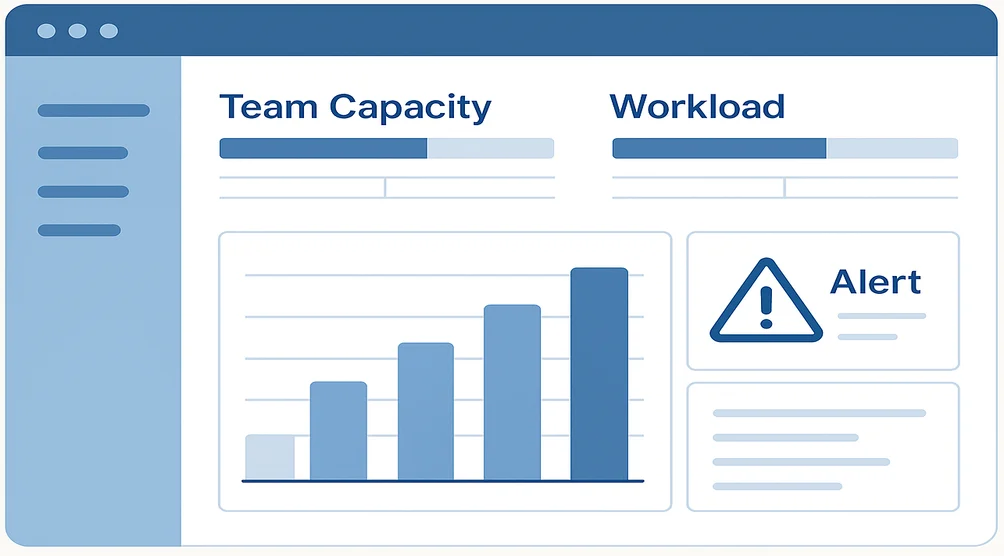
Effects of poor workforce allocation

Nine Workforce Allocation Actions

Match these actions to your specific situation. Start with simpler solutions before implementing major changes.

1. Redistribute Work Between Team Members

When some workers are overallocated while others are underutilized within the same team, move work from overloaded people to those with available capacity.

This requires clear visibility into who actually has bandwidth. Without it, a developer might work weekends while another team member operates at 50% capacity.

This works when underutilized people possess the skills needed for redistributed work.

2. Split Work Between Multiple People

Assign more than one person to work on the same activity when work items are too large for one person or to spread knowledge across the team.

A complex client implementation might overwhelm one project manager. Assigning senior and junior project managers together shares the load, reduces risk, and builds capability.

3. Increase Working Hours Within Limits

When a team faces temporary work surges, increase allocated working hours through overtime or flexible scheduling within legal and policy limits.

Accounting teams working extended hours during tax season is appropriate because it’s predictable and temporary. The key word is temporary—sustained overtime leads to burnout and declining productivity.

4. Reduce Working Hours

When a team has less work than capacity and utilization drops below targets, reduce allocated hours to match actual work available.

Customer support teams experiencing seasonal summer volume drops can adjust schedules rather than paying for unused capacity. This works when lower demand is temporary and you want to retain the team.

5. Share Work and Workers Between Teams

When some teams have surplus capacity while others with similar skill requirements face deficits, temporarily move work or workers between teams.

If marketing has excess design capacity while product desperately needs design support, temporarily assign a designer to help the product team. This requires coordination and managers willing to prioritize overall organizational success.

6. Reduce Total Work Demand

When a team faces persistent deficit even after trying actions 1-5, reduce the total work the team must complete by cutting low-priority activities or slowing delivery timelines.

If your development team is consistently overallocated, you might be building too many features simultaneously. Defer lower-priority features to match team capacity.

7. Increase Capacity by Adding Workers

When a team has persistent deficit that redistribution can’t resolve, and the work demand is both necessary and sustainable, recruit new employees or engage contractors.

If your sales team grows faster than implementation can handle, and the work is profitable and ongoing, hire additional implementation specialists.

This action has the longest timeline and highest cost, so ensure demand is lasting before committing.

8. Increase Demand for Surplus Capacity

When a team has persistent surplus capacity and you want to keep the team together, find or create additional work that productively uses available capacity.

If your IT infrastructure team automated many routine tasks creating excess capacity, use that capacity for infrastructure improvements you’ve postponed.

9. Reduce Capacity

When a team has persistent surplus capacity and lower demand is permanent, reduce total capacity through furloughs, layoffs, or ending contractor relationships.

If your organization shifted from on-premise to cloud-based software, the installation team faces permanently reduced demand. Reduce team size to match the new reality.

Choosing the Right Action

These actions follow a progression. Actions 1-5 redistribute existing work and capacity. They’re quick and low-cost. Start here.

Actions 6-9 change total demand or capacity. They take longer, cost more, and have bigger impact. Only use these when redistribution doesn’t work.

Context matters. A temporary surge needs a different response than permanent demand change. Skills that exist elsewhere enable different solutions than skills you don’t have anywhere.

Making Workforce Allocation Work

Effective workforce allocation requires visibility into who has capacity, who’s overloaded, and where work accumulates. Create simple tracking mechanisms. A spreadsheet showing allocated versus available hours works fine.

Review allocation regularly. Monthly reviews work for most situations, weekly for fast-moving environments. Empower managers to redistribute work, adjust schedules, or request help without elaborate approval processes.

Communicate transparently when increasing hours, moving people between teams, or reducing capacity. People accept difficult decisions more easily when they understand the reasoning.

The Bottom Line

Workforce allocation problems are normal as demand fluctuates and circumstances change. The difference between organizations that handle this well and those that struggle isn’t whether problems occur—it’s whether they identify and address issues before they escalate.

Start with visibility into allocation across your organization. Establish regular reviews. Give managers clear actions based on specific circumstances. The goal is identifying problems early and taking appropriate action before they damage performance.

Images created by : Chat GPT

Need systematic approaches to workforce allocation? Learn how BPTW Certification provides practical frameworks for managing capacity and workload effectively.

Quality of Hire: How to Measure Recruitment Success

You filled the position quickly and stayed under budget. But did you actually hire the right person?

Quality of hire answers this critical question. It reveals whether your recruitment process consistently brings in people who succeed in their roles and contribute to organizational goals.

Without measuring the quality of hire, you’re flying blind. You might be filling seats efficiently while building a workforce that under-performs. Here’s how to measure what actually matters.

Within structured human capital management systems such as HCM 3000, quality of hire is treated as a core recruitment effectiveness indicator rather than a standalone HR metric. It aligns recruitment decisions with workforce capability requirements and long-term performance outcomes, ensuring hiring activity supports organizational sustainability rather than short-term vacancy filling.

What Quality of Hire Actually Measures

Quality of hire assesses how well new employees align with job requirements and organizational expectations.

It’s the reality check for your recruitment process. When quality of hire metrics drop, something in your hiring system needs attention. Maybe your interviews don’t predict job success. Perhaps your candidate assessment methods miss what actually matters for performance.

This metric provides the evidence you need to improve recruitment systematically rather than guessing at problems.

International guidance such as ISO 30411 (Human resource management — Quality of hire metric) reinforces the need to define success criteria before hiring and evaluate outcomes after placement through structured quality of hire measurement.

Three Core Principles of Quality of Hire Measurement:

  • Comparative: actual performance versus defined expectations
  • Multidimensional: success includes performance, capability, and contribution
  • Time-based: measured at agreed milestones (3, 6, 9, or 12 months)

Understanding quality of hire connects directly to effective recruitment planning that sets clear success criteria from the start.

Why Quality of Hire Matters

Most organizations obsess over time-to-hire and cost-per-hire. These metrics matter, but they’re incomplete.

Hiring someone quickly and cheaply who then fails costs far more than taking longer to find the right person. Poor QoH creates cascading problems: lost productivity, team disruption, replacement costs, and damaged morale.

Quality of hire shifts focus from activity metrics to outcome metrics. Instead of celebrating how many positions you filled, you evaluate whether you hired people who actually succeed.

BPTW Best Place To Work® certification evaluates whether organizations consistently measure quality of hire and use results to improve recruitment decisions, onboarding effectiveness, and workforce allocation rather than treating hiring as a transactional activity.

Two Proven Measurement Approaches

Organizations typically use one or both of these methods to measure QoH.

Approach 1: Performance Against Objectives

This method evaluates new hires based on measurable performance objectives.

After a defined review period, compare actual achievement against assigned goals. Performance ratings link directly to organizational objectives and capture manager satisfaction with the hire’s contributions.

How it works: Calculate the mean performance rating for new hires during their first evaluation period. Compare this against your baseline expectation (typically your “acceptable” performance threshold).

If your acceptable performance rating is 3 on a 5-point scale and your new hires average 3.3, your quality of hire exceeds expectations by 11%. If they average 2.5, you have a recruitment problem to diagnose.

This approach integrates naturally with existing performance review systems. No need to create separate measurement processes.

Approach 2: Knowledge, Skills, and Abilities Assessment

This method uses structured questionnaires completed by hiring managers or key stakeholders.

They rate satisfaction with the new hire’s knowledge, skills, and abilities (KSAs) compared to pre-hire expectations. The assessment focuses on competencies critical for role success in your specific context.

How it works: Design a questionnaire covering essential KSAs for the role: technical knowledge, communication ability, problem-solving skills, relationship management, work quality, and timeliness.

Stakeholders rate each dimension on a defined scale. Calculate the mean rating across all dimensions. Compare this to your minimum expectation threshold.

If pre-hire expectation is a rating of 3 (acceptable) and the new hire averages 3.6 across all KSAs, quality of hire is 20% above expectations.

This measurement approach works particularly well when jobs don’t have easily quantifiable objectives or when you need granular insight into specific competency gaps. It also supports better candidate experience by clarifying what success actually looks like.


Choosing Your Quality of Hire Measurement Approach

Both approaches work. Your choice depends on organizational context and what you need to understand.

Use performance objectives measurement when jobs have clear, measurable goals and you already have established performance review processes. This approach integrates seamlessly with existing systems.

Use KSA assessment when you need detailed insight into specific competency gaps or when jobs don’t lend themselves to objective performance metrics. This works well for roles where success is more qualitative.

Many organizations use both methods for different role types or combine them for comprehensive assessment.

Critical Context Factors to Consider

Quality of hire doesn’t exist in isolation. Several factors influence your metrics and how you should interpret them.

Manager rating styles vary significantly. Some managers rate generously, others critically. Consistent low ratings from one manager might reflect their assessment approach rather than actual hire quality.

Choose appropriate timeframes. Decide whether to assess QoH at 3, 6, 9, or 12 months post-hire. Earlier assessment reveals onboarding and immediate fit issues. Later assessment shows sustained performance.

Different roles warrant different timeframes. Entry-level positions might be evident in three months. Senior technical roles may require twelve months for meaningful evaluation.

Quality of hire data feeds directly into workforce planning decisions by showing whether hiring pipelines are delivering the capabilities the organization actually requires.

Consider related metrics. QoH connects to cost-per-hire, time-to-fill, turnover rates, and retention. These relationships vary by organization size, sector, and growth phase.

High quality of hire with high turnover suggests problems in onboarding, management, or role clarity rather than recruitment. Low quality with long time-to-fill might indicate overly restrictive selection criteria that filter out capable candidates.

Making Quality of Hire Actionable

Measurement without action wastes effort. Quality of hire metrics should drive systematic improvement.

When QoH metrics fall below standards, investigate:

  • Are job descriptions attracting appropriate candidates?
  • Do assessment methods actually predict job success?
  • Is selection criteria aligned with what roles require?
  • Are hiring managers making consistent, objective decisions?
  • Does onboarding adequately prepare new hires for success?

Low quality of hire often reveals flaws in process design rather than bad luck with candidates. Use data to fix your recruitment system systematically.

Track trends over time. Single data points tell you little. Monitor QoH across multiple hiring cycles to identify patterns and measure improvement from process changes.

Close the feedback loop. Share quality of hire data with everyone involved in recruitment. When recruiters and hiring managers see how their selections perform, they make better future decisions.

Getting Started with Quality of Hire Measurement

Implementation steps:

  1. Define expectations before hiring – Document minimum acceptable performance levels and key competency requirements
  2. Choose your measurement approach – Select performance-based, KSA-based, or both depending on role types
  3. Set evaluation timeframes – Decide when to measure quality of hire (3, 6, 9, or 12 months)
  4. Standardize your measurement – Use consistent scales, time frames, and methods across similar roles
  5. Train evaluators – Ensure managers understand how to rate quality of hire fairly and consistently
  6. Analyze results regularly – Review quality of hire quarterly to identify trends
  7. Act on findings – Use quality of hire data to improve recruitment processes systematically

Effective workforce allocation depends on hiring quality talent in the first place. QoH measurement ensures your recruitment investments pay off.

Conclusion

Quality of hire transforms recruitment from activity-focused to outcome-focused.

It reveals whether your hiring process delivers people who actually succeed, not just whether you’re filling positions efficiently. This matters because recruitment effectiveness directly impacts organizational performance and competitive advantage.

Organizations that measure QoH systematically make better recruiting decisions over time. They learn which approaches work, which don’t, and how to continuously improve.

Start measuring the QoH, and you’ll stop guessing whether your recruitment process works.

Ready to strengthen recruitment outcomes and accountability?

BPTW certification assesses how organizations measure and improve quality of hire within structured human capital management systems, ensuring recruitment decisions support long-term performance.

Upcoming Webinar : Learn About BPTW – Best Place to Work

Join our upcoming webinar to learn how BPTW certification can help your organization build structured people systems that drive business success.

Date:

10th september 2025

Time:

4.00 PM - 4.30PM IST